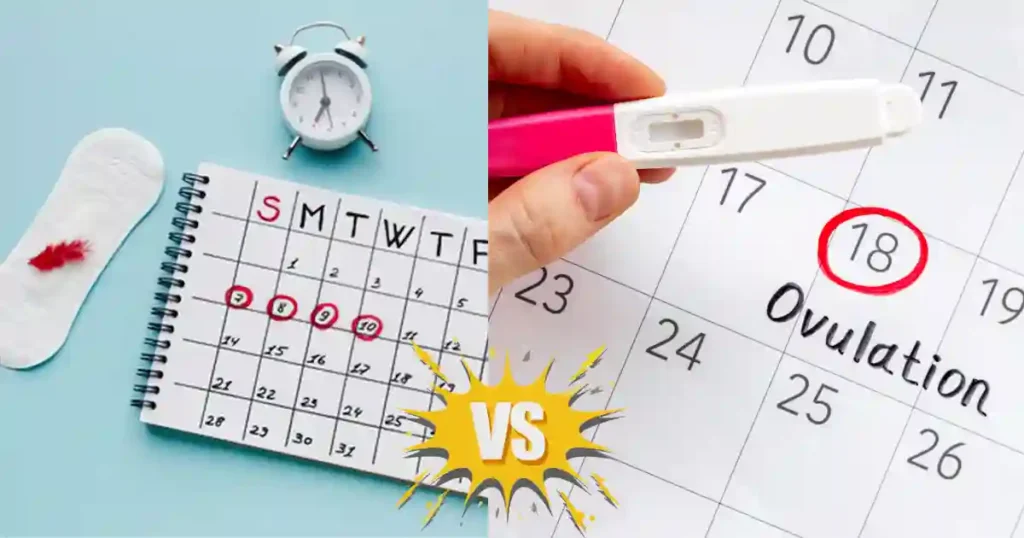
Choosing between an ovulation calculator vs period tracker was a confusion I held onto for longer than I should have. For the first two years of tracking my cycle, I used a period tracker and assumed its fertile window prediction was the same thing as an ovulation prediction. It was not. Period trackers and ovulation calculators look nearly identical in many apps, but they measure different things, answer different questions, and serve different purposes. This guide explains exactly how each tool works, where each one succeeds, where each one fails, and how using both together gives you the most complete fertility picture available from home-based tracking.
Understanding the Basics: Ovulation vs Period Tracking
Many users confuse period trackers with ovulation calculators. Both involve cycle data. Both produce date predictions. But each serves a fundamentally different purpose.
What Is an Ovulation Calculator
An ovulation calculator is a tool that estimates your fertile window based on your cycle data. It takes inputs like your last period date, average cycle length, and in more advanced versions, basal body temperature or LH surge results. From those inputs, it applies a formula to estimate when ovulation is likely to occur and identifies the five to six days around that event as your fertile window.
The goal of an ovulation calculator is conception planning. It is designed specifically to tell you when you are most likely to be able to get pregnant. The fertile window calculation is the core output. Everything else the tool does is secondary to that function.
What Is a Period Tracker
A period tracker is a tool that monitors menstruation dates, flow intensity, cycle length trends, and symptoms across multiple months. It records when your period starts and ends, how heavy the flow is, and whatever symptoms you log alongside it.
Period trackers excel at predicting when your next period will arrive. They identify whether your cycles are lengthening or shortening over time. They help you anticipate PMS, spotting, and other cycle-related symptoms by showing you the pattern of your recent months.
Most period trackers also display a predicted fertile window or ovulation day. This is where the confusion starts. Ovulation prediction from a period tracker that only uses dates is highly inaccurate. To predict ovulation, a fertility awareness-based method needs to be measured directly. The period tracker’s fertile window display is a calendar estimate based on your average cycle length. It is not an ovulation calculator.
A Real-Life Context
Using a period tracker in Salt Lake City, Utah and assuming it was accurately predicting my ovulation was an expensive mistake in months of trying to conceive. The app showed a green fertile window from days 10 to 16 every single cycle. It never shifted regardless of what my body was doing. One cycle when I finally added OPK strips, my LH surge arrived on day 19. The period tracker had no idea. The green window had already passed days before my actual surge. That one experience clarified the difference between the two tools more clearly than any explanation could.
How Ovulation Calculators Work vs Period Trackers
Each tool operates from different inputs and produces different types of output. Understanding the methodology explains why each tool is suited to its specific purpose.
Data Inputs for Ovulation Calculators
Ovulation calculators use some or all of the following inputs: the date of your last period, your average cycle length, and optionally, historical cycle length data to refine the average. More advanced ovulation calculators integrate BBT readings, cervical mucus observations, and OPK test strip results to produce predictions that are grounded in physiological data rather than calendar math alone.
Apps like Natural Cycles, Ovia Fertility, and the ovulation-specific features of Flo allow users to enter these additional data points. The more physiological data you provide, the more the tool transcends a simple calendar formula and approaches individualized prediction.
Data Inputs for Period Trackers
Period trackers use the start date, end date, and flow intensity of each period. Some allow logging of additional cycle symptoms: mood, energy level, cramps, spotting, headaches, and PMS-related symptoms. These inputs help the tracker build a symptom pattern profile alongside the cycle length pattern.
The limitation is that none of these inputs provide direct information about when ovulation occurs in any given cycle. Period trackers identify cycle length. They do not measure the hormonal event of ovulation. Everything beyond that distinction is how each tool uses its inputs differently.
A Real-Life Context
The clearest illustration comes from a clinical study. Of 36 predictions made by 10 period tracker apps for ovulation day across four women’s profiles, only 3 predictions (8%) were exactly correct. Nine predicted one day too early, and 67 percent of predictions were two to nine days earlier than the actual ovulation day. That is the performance of period trackers when used to predict ovulation. Using them for that purpose leads to systematically miscalculated fertile windows.
Accuracy and Limitations of Both Tools
Understanding where each tool succeeds and where it fails is the most important practical knowledge for anyone tracking fertility.
Accuracy of Ovulation Calculators
Ovulation calculators work best with regular, consistent cycles. When cycle length is stable month to month, the formula applied to a reliable average produces reasonably useful predictions. There are about six days during each menstrual cycle when you can get pregnant. This is called your fertile window. The typical cycle is 28 days, but each woman is different. A calculator translates that biological framework into a personalized calendar estimate.
The accuracy drops for irregular cycles, for cycles affected by stress, illness, or lifestyle disruption, and for users whose ovulation day consistently diverges from the day-14 assumption. For irregular cycles, PCOS, or thyroid conditions, ovulation calculators are significantly less reliable.
They work best alongside symptom tracking and LH test strips that provide real-time confirmation of the predicted window. A 2020 study published in JAMA Internal Medicine evaluated five popular cycle tracking apps and found they had an average accuracy of 21 to 22 percent for predicting the fertile window. The study found that while apps were useful for understanding general cycle patterns, their predictions were not precise enough for reliable fertility planning, with an average error in predicting ovulation of about six days earlier or later than the actual ovulation date.
Accuracy of Period Trackers
Period trackers are excellent at what they were designed for: predicting your next period date and identifying long-range cycle trends. They are not reliable predictors of ovulation when used alone.
Period tracker apps should ensure they only give women accurate information, especially for the day of ovulation and the fertile window, which can only be predicted if using a marker of ovulation such as basal body temperature, ovulation sticks, or cervical mucus. That is the clinical consensus on what period trackers can and cannot do.
The irony is that many users search for a period tracker precisely because they want to track their fertile window. The app delivers a fertile window display. The user assumes it is accurate. The research consistently shows it is not, at least not without additional physiological data inputs.
Expert Opinion
“For conception, an ovulation calculator is more precise, but period trackers give vital context for your cycle,” says Dr. Jessica Shepherd, a Dallas, Texas-based board-certified OB-GYN and FACOG, founder of Sanctum Med and Wellness, Chief Medical Officer of Hers, and author of Generation M: Living Well in Perimenopause and Menopause. Dr. Shepherd completed her residency at Drexel University College of Medicine and a fellowship in Gynecologic Endoscopy and Minimally Invasive Surgery at the University of Louisville. She was previously Director of Minimally Invasive Gynecologic Surgery at the University of Illinois at Chicago, serves on the Advisory Board for Women’s Health Magazine and Women’s Health.org, and is a regular contributor on Good Morning America and The Today Show.
Her framing captures the functional relationship between the two tools exactly: the period tracker provides the long-range cycle context that makes an ovulation calculator more accurate. The ovulation calculator provides the fertility-specific prediction that the period tracker cannot reliably produce.
Comparing Ovulation Calculators vs Period Trackers
Here is a clear, side-by-side comparison of both tools across the dimensions that matter most for practical fertility tracking.
| Feature | Ovulation Calculator | Period Tracker |
|---|---|---|
| Primary purpose | Predict fertile window and ovulation | Track menstruation dates and cycle patterns |
| Accuracy for ovulation prediction | Medium to high with consistent inputs | Low when used alone for this purpose |
| Handles cycle irregularity | Better with range inputs and multi-signal data | Detects patterns but cannot correct for hormonal shifts |
| Recommended for trying to conceive | Yes, as primary fertility tool | Optional, for cycle context only |
| User effort required | Moderate to high, more data inputs | Low, period start and end dates |
| Best additional benefit | Identifies fertile window for conception timing | Anticipates period dates, PMS, and spotting |
| Improves with more data | Yes, significantly | Yes, cycle length prediction improves |
How to Use Both Tools Together for Maximum Accuracy
Using an ovulation calculator and period tracker together provides better fertility insights than either tool alone.
Step 1: Track Periods First
Start by using a period tracker to log three to six months of cycle start dates, end dates, and flow information. This builds the historical cycle length data that makes an ovulation calculator’s prediction meaningful.
Three months of logged period data gives you a working average cycle length. Six months gives you a confident, representative range. That data becomes the foundation for every ovulation prediction tool you use going forward.
Step 2: Use an Ovulation Calculator
With your period tracking data in hand, input your average cycle length and your most recent period start date into an ovulation calculator. Review the predicted fertile window it generates.
For irregular cycles, input both your shortest and longest recent cycle lengths and calculate the combined fertile window range, as described in earlier guides in this series. Use the calculator’s output as the guide for when to begin watching for physical signs and testing with OPK strips.
Step 3: Monitor Symptoms and LH Surge
Add at least one real-time physical observation method alongside your tools. Check cervical mucus daily after your period ends. Watch for the shift to clear, stretchy, egg-white-quality discharge that signals rising estrogen and approaching ovulation.
Add OPK strips during the predicted fertile window for biochemical confirmation of the LH surge. Add BBT tracking every morning to confirm the post-ovulatory temperature shift across multiple cycles.
Period tracker data provides the context: what are my cycles typically doing? Ovulation calculator prediction provides the timing estimate: when should I start watching this cycle? Physical signs and OPKs provide the real-time confirmation: is the fertile window actually open right now?
A Real-Life Insight
Using both tools together was the change that finally made sense of a 33-day cycle that had confused me for months. The period tracker showed me that my cycles had been consistent at 32 to 34 days across six months. The ovulation calculator, using that range, predicted ovulation between days 18 and 20. My OPK strips confirmed the surge on day 19. My BBT confirmed the temperature rise two days later. Each tool played its specific role. Together they gave me a reliable fertile window that I never had when I relied on the period tracker’s built-in prediction alone.
Common Mistakes Users Make
Even with the right tools, specific errors reduce tracking accuracy significantly.
Mistake 1: Ignoring Irregular Cycles
Entering a single cycle length that does not reflect your actual variation means the ovulation calculator’s output misrepresents your real fertile window. Track multiple months and adjust inputs to reflect your actual personal range, not an idealized average or the default 28-day setting.
Mistake 2: Using Only One Tool
Relying solely on a period tracker for fertile window information frequently misleads trying-to-conceive efforts. 29.7 percent of period tracker users stated the best thing about using a period tracker was knowing when they were ovulating, and 10.9 percent said they avoid having sex on the fertile days predicted by the app. Both groups are using the tool for a purpose it cannot reliably serve alone.
The fix is to combine the period tracker for cycle context with an ovulation calculator for prediction and physical methods or OPK strips for real-time confirmation.
Mistake 3: Forgetting Lifestyle and Health Factors
Stress, illness, travel, and significant weight or exercise changes all shift actual ovulation timing. Neither a period tracker nor an ovulation calculator can detect or account for these current-cycle disruptions. Log lifestyle context notes in your app so that unexpected timing shifts have explanatory context rather than creating unnecessary anxiety.
Common Mistakes and Solutions Reference Table
Here is a clear summary of the most common tracking mistakes and how to correct each one.
| Mistake | Effect | How to Fix |
|---|---|---|
| Using period tracker alone for ovulation prediction | Missed fertile window by 2 to 9 days in most cycles | Add dedicated ovulation calculator and OPK confirmation |
| Ignoring cycle irregularity in calculator inputs | Narrow prediction misses actual timing | Enter your full cycle length range, not just a single average |
| No symptom or OPK tracking | Calendar prediction untested against real biology | Add cervical mucus observation and OPK testing to every cycle |
Tips for Choosing the Right App or Calculator
The right tool depends on your goals, cycle type, and how much data you want to manage.
User-Friendly Interface
Look for apps with visual calendar displays that make cycle data easy to read at a glance. Reminder notifications for testing windows and symptom logging reduce the friction of daily tracking habits. Simple, intuitive logging reduces the chance you skip entries on busy days.
Customization for Irregular Cycles
Choose an app that allows cycle length range inputs rather than only a single fixed average. PCOS-specific or irregular cycle modes in apps like Flo provide wider fertile window estimates that more honestly reflect biological variation. The ability to log OPK results and BBT alongside calendar data is especially important for irregular cycle users who need physiological data inputs to supplement calendar prediction.
Expert-Recommended Apps
Apps like Clue, Flo, Ovia, and Natural Cycles are consistently recommended for their combination of usability, data privacy practices, and multi-signal input capabilities. Natural Cycles is FDA-cleared as a digital contraceptive for users with regular cycles, reflecting its clinical validation. Clue has a strong reputation for privacy protection and evidence-based health content.
Whatever app you choose, review its privacy policy before entering detailed personal health data. As established in earlier articles in this series, fertility apps vary widely in how they handle user data. Choose apps that clearly state they do not sell personal health information.
A Real-Life Insight
Switching from a generic period tracker to Clue, which allows entry of irregular cycle lengths, cervical mucus observations, and OPK results alongside period dates, changed the quality of my tracking data immediately. The predictions became more useful because they were based on more of my actual cycle data rather than only my average period start dates. The tool you choose shapes the data you can enter, and the data you enter shapes the quality of the prediction.
QA About Ovulation Calculators and Period Trackers
Can Period Trackers Predict Ovulation Accurately?
Not reliably when used alone. Period tracker apps should only give women accurate information about ovulation and the fertile window if using a marker of ovulation such as basal body temperature, ovulation sticks, or cervical mucus. The calendar-based fertile window display in most period trackers is a formula estimate with documented high error rates. Use period trackers for cycle pattern awareness and period prediction. Use a dedicated ovulation calculator with additional physiological data inputs for fertile window prediction.
Can I Rely Only on an Ovulation Calculator?
It works best for regular cycles and improves significantly when you add physical confirmation methods. The error in ovulation prediction from calendar-based apps averages about six days earlier or later than actual ovulation in research studies. Combining the calculator with OPK strips and cervical mucus observation dramatically reduces that error.
How Long Should I Track My Cycle Before Relying on Predictions?
At least three cycles for a working baseline. Six cycles give confident, representative data. Cycle length varies by seven or more days in more than 46 percent of women aged 18 to 40, and by 14 or more days in 20 percent of women in the same age range. That natural variation is why more data consistently produces better predictions.
Are Apps Safe and Private?
They vary widely. As covered in the earlier article on ovulation app privacy in this series, many apps share health data with third parties, and some have faced regulatory action for deceptive privacy practices. Choose apps with clear policies against selling user data, prefer local over cloud-only storage where available, and review app permissions carefully at installation.
Practical Advice for Trying to Conceive Using Both Tools
Combining both tools with physical methods gives you the most reliable fertility tracking available outside a clinical setting.
Track Consistently
Log period start dates in your period tracker every cycle without fail. Enter OPK results daily during your testing window. Note cervical mucus texture each morning. Take BBT at the same time before any activity. Consistent data in equals useful predictions out.
Be Flexible With Predictions
Period tracker and ovulation calculator predictions are estimates. Irregular cycles shift fertile windows. Lifestyle changes push timing earlier or later. Physical signs and OPK results are what tell you where the fertile window actually falls in any given cycle. Stay flexible with the predictions and responsive to what your body is showing you.
Combine Methods for Best Results
Period tracker for cycle pattern context, plus ovulation calculator for timing prediction, plus OPK strips for biochemical confirmation, plus cervical mucus observation for daily real-time physical data, plus BBT for post-ovulatory confirmation. Each layer fills a gap the others leave open. Together they provide the most reliable home-based fertile window identification currently possible.
A Personal Reflection
Patience and consistent observation beat relying solely on apps. That is the honest summary of what I learned after years of tracking fertility with various tools. The apps organize and visualize. They do not replace the daily habit of paying attention to what your body is telling you in real time. When I stopped outsourcing my cycle awareness entirely to an app’s prediction and started actively observing my physical signs daily, the quality of my fertile window identification improved immediately and meaningfully.
Ovulation Calculators vs Period Trackers
Each tool has clear strengths. Period trackers excel at cycle awareness, period prediction, and symptom pattern recognition. Ovulation calculators provide the fertility-specific prediction that period trackers cannot reliably deliver alone.
Combined use, with physical signs and OPK confirmation added as the real-time layer, maximizes conception chances and produces the most accurate fertile window identification achievable from home-based tracking.
Final Recommendation
Understanding the difference between an ovulation calculator vs period tracker is the foundation of effective fertility tracking. From personal experience and from studying the research thoroughly, the clearest practical advice is this: use a period tracker to log all your cycle start dates and build a six-month personal cycle length history, then use a dedicated ovulation calculator or fertility app to generate your predicted fertile window from that history.
Start OPK testing from a few days before the calculator’s predicted ovulation date, testing daily at the same time, and continue until you see a clear positive. Observe cervical mucus every day from the end of your period as your free real-time physical layer. Add BBT tracking over two to three cycles to build your personal post-ovulatory temperature baseline. Never rely on a period tracker alone for ovulation prediction, because research consistently shows its fertile window estimates are wrong by two to nine days for most users.
Choose apps with strong privacy policies and ideally local data storage. If after three to six months of consistent combined tracking you still cannot identify a clear fertile window through OPK results and BBT, book an appointment with a gynecologist or reproductive endocrinologist. Your organized tracking data gives that consultation an immediately productive and well-documented starting point.
FAQs
What is the difference between an ovulation calculator vs period tracker?
An ovulation calculator vs period tracker serves different goals. An ovulation calculator estimates fertile days, while a period tracker records cycles, symptoms, and predicts future periods.
Which is more useful: ovulation calculator vs period tracker?
It depends on your goal. Ovulation calculators vs period trackers both help, but ovulation tools focus on fertility, while trackers focus on overall cycle patterns and period timing.
Can I use an ovulation calculator vs period tracker together?
Yes, using both is helpful. An ovulation calculator vs period tracker combo gives better insight into cycles, fertility windows, and patterns over time.
Is an ovulation calculator vs period tracker more accurate?
Neither is perfect on its own. Ovulation calculators vs period trackers rely on data input, so accuracy improves with consistent tracking and regular cycles.
Do ovulation calculators vs period trackers work for irregular cycles?
Yes, but with limits. Ovulation calculators vs period trackers may give estimates, but irregular cycles can make predictions less exact, so extra tracking helps.
Which is better for trying to conceive: ovulation calculator vs period tracker?
Ovulation calculators are better for timing fertile days. Period trackers help understand cycles, so using both ovulation calculator vs period tracker is often most useful.
What should beginners choose: ovulation calculator vs period tracker?
Beginners can start with a period tracker to learn cycle patterns. Then add an ovulation calculator vs period tracker approach to better identify fertile windows.