Learning about the common mistakes when tracking ovulation changed my entire approach to cycle awareness. I had been testing every morning at seven, drinking coffee first, reading faint lines as positives, and trusting app predictions as absolute facts. Every single one of those habits was quietly undermining the accuracy of my data. The frustrating part is that these mistakes are not obvious at first. They are small, easy to miss, and incredibly common. This guide covers every major error people make across OPK testing, BBT tracking, app use, lifestyle interference, and cycle interpretation, so you can avoid months of confusion and start getting reliable results right away.
Understanding Ovulation Tracking
Tracking ovulation seems simple. But small mistakes in technique, timing, or tool use can throw results off completely.
Why Tracking Ovulation Matters
Ovulatory disorders and mistiming intercourse are both primary causes of infertility, and tracking ovulation is shown to decrease average time to conception. That is a direct clinical statement about why this matters in practice, not just in theory.
Accurate tracking helps you identify your fertile window with precision. It supports conception planning by revealing when to time intercourse. It also builds long-term cycle awareness that can flag irregularities, luteal phase defects, or anovulatory cycles before they become undetected fertility issues.
For those trying to conceive, mistiming intercourse by even one to two days can mean missing the window entirely in a cycle where the egg only survives for 12 to 24 hours.
Common Methods of Ovulation Tracking
The main home-based tracking methods are LH test strips or digital OPKs, basal body temperature (BBT) charting, and cycle tracking apps or wearable devices. Each of these methods has specific strengths and specific failure modes. Understanding the failure modes is exactly what prevents the most common tracking mistakes.
OPKs detect the LH surge directly in urine. BBT confirms ovulation has occurred through a post-ovulatory temperature rise. Apps predict the fertile window algorithmically based on cycle history. Wearables track physiological signals continuously. None of these methods is perfect on its own, and combining them reduces the errors each one carries independently.
A Real-Life Context
My first tracking error was a classic. I tested every morning at seven. I drank my coffee before checking the strip. I read the result at twelve minutes. Every single element of that routine was wrong. LH concentrations are lower in first morning urine than later in the day. Excessive fluid intake before testing dilutes LH below the detection threshold. Reading a strip after ten minutes introduces evaporation line artifacts that look like faint positives. Three mistakes in one routine, and I had no idea for two full cycles that my data was unreliable.
Mistakes in Timing Your Ovulation Tests
Even a small timing error can skew results significantly. This is where most tracking mistakes begin.
Testing Too Early or Too Late
Starting OPK testing too early in your cycle wastes strips and produces no useful data. Starting too late means you may miss the LH surge entirely if it is brief.
Ovulation occurs an average of 24 hours after the LH surge first begins. The LH surge can last anywhere from a couple of hours to a couple of days. By the time you get a positive LH test, there may not be much time left before ovulation depending on the timing of your surge. This is why starting testing a few days before your estimated ovulation date and testing consistently until you see a positive is essential.
For a 28-day cycle, start testing around day ten. For a 32-day cycle, start around day fourteen. For a 24-day cycle, start around day eight. Starting OPK testing based on your own average cycle length, not on a generic day-14 assumption, is the first timing correction many people need to make.
Inconsistent Testing Times
Testing at different times each day produces inconsistent LH concentration readings. LH is produced in the early morning hours. It takes several hours to appear in urine at detectable concentrations. Testing at 7 AM one day and 3 PM the next gives you two very different points on the daily LH curve, making the comparison unreliable.
Test at the same time each day. Midday to early evening, between 10 AM and 8 PM, gives the most reliable results. Ideally, test between noon and 6 PM and hold your urine for at least two to four hours before testing without excessive fluid intake.
A 2024 fertility guide found that 70 percent of women detect surges with twice-daily testing. If you have a short or hard-to-detect LH surge, testing both at midday and in the early evening in the days around your estimated ovulation date gives you twice the chance of catching it.
Misreading Cycle Length
Assuming every cycle is 28 days long is one of the most widespread mistakes in ovulation tracking. Period tracking apps work by estimating when you ovulate based on your average cycle length. These apps operate using the calendar method, which assumes that ovulation occurs 14 days before your next cycle begins. So if you tell the app that your average cycle length is 30 days, the app will always predict ovulation on day 16.
That may not be a problem for someone who has a consistent 30-day cycle every month. But for someone with irregular cycles, apps based on a consistent average will not be able to provide accurate fertile window predictions. A study involving data from more than 600,000 cycles found that most cycles did not follow the same timeline month to month, and the largest source of variation was the follicular phase, the part before ovulation.
Track three to six actual cycles before relying on any app prediction. Use those cycles to calculate your real personal average, not an assumed one.
Mistakes Using Ovulation Test Kits
OPKs are highly accurate tools. But only when you use them correctly.
Misinterpreting Test Results
The most frequent OPK misread is interpreting a faint test line as a positive result. A positive OPK requires the test line to be as dark as or darker than the control line. Any line lighter than the control line, no matter how visible, is not a positive surge result. It simply indicates that LH is present below the positive threshold.
Line-based tests are subjective and often misread, leading to inconsistent or incorrect interpretation of results, commonly called “line eyes.” This subjectivity is the primary reason digital OPKs exist. Digital tests display a symbol rather than a line, removing interpretation from the equation entirely. Ninety percent of digital OPK users report clear results according to a 2024 fertility report.
If you are using strips and finding the comparison difficult, photograph each strip in the same lighting at the same angle so you can visually compare the progression across days. The darkening of the test line as it approaches the surge becomes visually clear in a photo series in a way it may not be when looking at a single strip in isolation.
Not Following Instructions
Two specific instruction violations cause the most OPK errors: testing with first morning urine and reading the result after the designated window.
First morning urine can give artificially elevated baseline LH readings or miss the start of a surge that begins building after wake-up. As noted above, midday to early evening testing gives more reliable results.
Reading a strip after ten minutes introduces evaporation line artifacts. A faint line that was not present at five minutes may appear at fifteen minutes. This is not a positive result. It is a drying artifact. Always read OPK results within the specific time window stated in the product instructions, typically between three and ten minutes depending on the brand.
A Real-Life Insight
One month I got what looked like a positive on day eight. I was excited. I noted it in my app. I adjusted my timing around it. Then I saw that I had checked the strip at fifteen minutes because I got distracted. That faint line at fifteen minutes was an evaporation artifact, not an LH surge. My actual positive came four days later. That one careless delay in reading cost me almost an entire week of misinterpreted data in a cycle where timing was important.
Mistakes Using Ovulation Apps and Wearables
Apps and wearables are powerful long-range tools. But specific errors in how they are used significantly reduce their value.
Skipping Data Entry
Apps rely on consistent input. Cycle tracking methods are only as good as the data you give them. Since period tracker apps only use the dates of your period and no other data from your body, they are not always accurate even under ideal conditions. When data entry is inconsistent, skipping BBT readings, not logging OPK results, or forgetting to mark period start dates accurately, the app’s algorithm works with incomplete information and produces less reliable predictions.
Log data every day. It takes under 60 seconds to enter a BBT reading and a one-word symptom note into a tracking app. That daily investment builds the cumulative data that makes predictions meaningful. An app with six months of consistent entries produces significantly better predictions than one with sporadic input across the same period.
Relying Solely on Apps
Calendar-based apps predict fertile windows based on historical averages. They cannot adapt to what your body is doing in the current cycle. Almost 7 out of 10 cycles with a calendar-based tracking method contained at-risk days where the user was told they were not at risk for pregnancy when they actually were. That is a very high rate of prediction error that demonstrates clearly why app predictions alone are not sufficient as fertility indicators.
An app that predicts ovulation on day 14 based on your history has no information about this month’s work stress, illness, poor sleep, or travel. The app shows the same prediction regardless. An OPK catches the actual LH surge whenever it occurs, regardless of what the calendar suggests.
Ignoring Wearable Signals
Some people invest in a wearable tracker and then wear it inconsistently, fail to calibrate it as directed, or skip nights when charging is interrupted. Wearables need at least two to three cycles of consistent nightly use to build a reliable personal physiological baseline. Skipping nights creates gaps in the temperature record that degrade algorithm accuracy.
The Oura Ring detected 96.4 percent of ovulations with an average error of plus or minus 1.26 days in a 2025 validation study. But that accuracy requires consistent use. A device worn only four nights out of seven does not have enough data to produce that level of reliability.
Lifestyle Mistakes That Affect Tracking
Your body is sensitive. Small changes in daily habits create real and measurable impacts on tracking accuracy.
Stress and Sleep
Stress is both a common tracking mistake trigger and a direct cycle disruptor. Elevated cortisol suppresses the hypothalamic signals that drive ovulation. A high-stress period can delay ovulation by several days, causing OPK tests in the app’s predicted window to come back negative when the actual surge has not yet occurred.
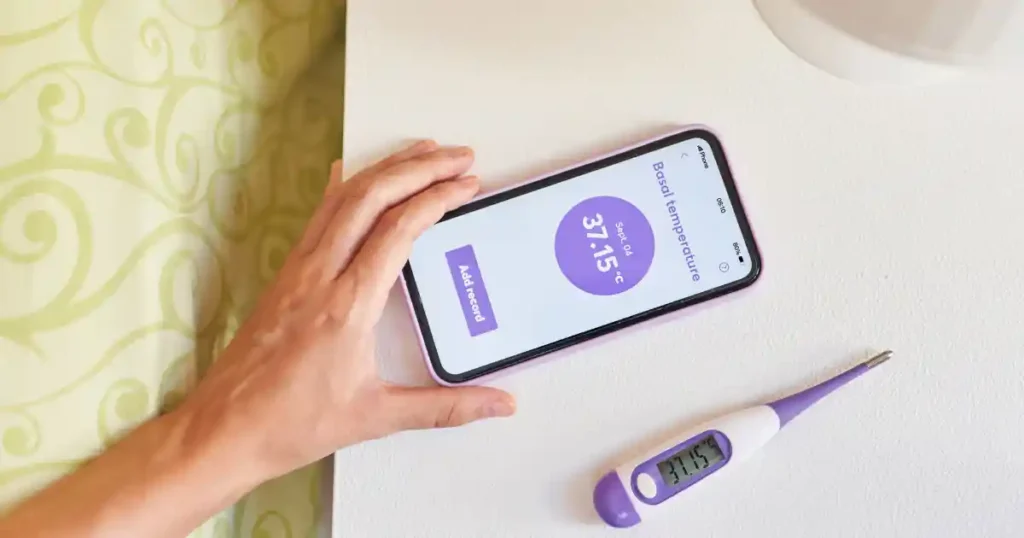
Poor sleep affects BBT readings directly. BBT is your resting temperature. Any disruption to normal sleep, a late night, alcohol before bed, a restless night, or waking before your usual time and going back to sleep, can alter the morning reading by tenths of a degree. Those small variations make the temperature chart harder to interpret.
The standard guidance from StatPearls confirms that accurate BBT results are dependent on consistent measurements every morning at the same time before any activity. Even sitting up for two minutes before taking your temperature can raise the reading enough to obscure the ovulatory thermal shift pattern.
Illness or Medications
A fever raises BBT significantly. Even a low-grade infection that does not feel dramatic can produce temperature elevations that look like a post-ovulatory rise when none has occurred, or that obscure the actual thermal shift in the luteal phase. Note any illness in your tracking log with the dates so you can identify and exclude those readings when interpreting your chart.
Fertility medications containing LH or hCG can produce false OPK positives. Certain other medications, including some antipsychotics, anticonvulsants, and high-dose thyroid medications, can affect LH levels or body temperature patterns. If you are on any regular prescription medication, check with your prescriber about potential effects on LH test or BBT readings.
Hormonal birth control suppresses ovulation entirely. OPKs will not show a surge while on combined hormonal contraception. Once stopped, ovulation typically returns within weeks to months depending on the method, as discussed in previous guides on this topic.
Diet and Exercise
Extreme calorie restriction reduces estrogen production below the threshold needed for regular ovulation. Very high training volume without adequate caloric intake suppresses the HPO axis through a condition called Relative Energy Deficiency in Sport. Both scenarios produce delayed or absent ovulation that tracking tools will reflect as a long cycle without a clear LH surge or thermal shift.
Hydration directly affects OPK accuracy. Testing with very diluted urine, from drinking excessive fluids in the hours before testing, reduces urinary LH concentration. Water consumption and other factors may affect urine dilution, making the most accurate approach to avoid excessive fluid intake before testing.
Combined Tracking Mistakes Reference
Here is a clear summary of the most common mistakes, a specific example of each, and how to fix them.
| Mistake Category | Specific Example | How to Avoid It |
|---|---|---|
| Timing errors | Testing at 7 AM with coffee before testing | Test midday to early evening, avoid fluid overload |
| Misreading OPK results | Calling a faint line positive before reading the control | Match or exceed control line; use digital OPKs |
| Reading outside the window | Checking strip at 15 minutes | Read within 3 to 10 minutes per brand instructions |
| Inconsistent tracking | Skipping app entries for 3 days | Log daily with phone reminders |
| Lifestyle interference | Measuring BBT after getting up to use the bathroom | Take BBT before any movement immediately upon waking |
| Misunderstanding cycle timing | Using day 14 prediction for a 32-day cycle | Use your personal average: subtract 14 from cycle length |
| Relying on one method | Using only an app without OPK confirmation | Combine app prediction with OPK and BBT confirmation |
Expert Advice on Avoiding Tracking Mistakes
“Many people fail not because of the tools. They fail because they are inconsistent or misread results,” says Dr. Jessica Shepherd, a Dallas, Texas-based board-certified OB-GYN and FACOG, founder of Sanctum Med and Wellness, Chief Medical Officer of Hers, and author of Generation M: Living Well in Perimenopause and Menopause. Dr. Shepherd completed her residency at Drexel University College of Medicine and a fellowship in Gynecologic Endoscopy and Minimally Invasive Surgery at the University of Louisville. She was previously Director of Minimally Invasive Gynecologic Surgery at the University of Illinois at Chicago, serves on the Advisory Board for Women’s Health Magazine and Women’s Health.org, and is a regular contributor on Good Morning America and The Today Show.
Her observation captures the core issue perfectly. The tools themselves are accurate when used correctly. Most tracking failures are not tool failures. They are consistency failures, interpretation failures, or lifestyle interference failures. All three are entirely within your control to fix.
Tips From Experts
Combine multiple methods. Use BBT plus OPK strips plus app tracking together. Each method catches what the others miss. OPKs provide biochemical confirmation that no app can replicate. BBT confirms the post-ovulatory shift that OPKs cannot show. Apps provide the historical context and cycle-length estimates that help you know when to start testing.
Track for at least two to three full cycles before drawing conclusions. One unusual cycle is not a pattern. Two unusual cycles might be coincidence. Three cycles of data reveal your actual personal ovulation timing reliably enough to act on.
Do not overreact to a single abnormal result. One flat BBT chart does not confirm anovulation. One long cycle does not mean PCOS. Patterns across multiple cycles are what matter. Single-cycle anomalies from stress, illness, or travel are common and expected.
A Real-Life Insight
It is tempting to panic after one off-cycle. Your period is late. Your OPK never turned positive. Your temperature chart looks flat and confusing. The instinct is to spiral. But fertility tracking is a marathon, not a sprint. One messy cycle tells you almost nothing. Three cycles of consistent data, even imperfect data, tell you a great deal. Hold the perspective. Keep tracking. The pattern will emerge.
Mistakes That Affect Interpretation of the Fertile Window
Even accurate tracking data can be misread at the interpretation stage. These are the most common analytical errors.
Confusing Ovulation With PMS or Mid-Cycle Spotting
Cervical mucus changes can be misleading when interpreted in isolation. Some people experience brief increases in cervical discharge mid-cycle that do not represent peak fertile mucus. PMS symptoms like bloating or mild cramping in the luteal phase can be mistaken for ovulatory symptoms.
Mid-cycle spotting can occur around ovulation due to the estrogen drop just before the LH surge. This is called ovulatory spotting and is normal. But it can be confused with implantation bleeding or intermenstrual bleeding from other causes. Note spotting with its color, texture, and amount in your tracking log. Light, clear-to-pink spotting mixed with fertile-quality mucus around mid-cycle is consistent with ovulatory spotting. Heavier or darker mid-cycle bleeding warrants medical evaluation.
Physical signs support tracking but should not replace biochemical confirmation. An OPK positive and a BBT shift are the most reliable anchors for interpreting what your physical signs mean in any given cycle.
Ignoring Irregular Cycles
Assuming your cycle is regular when it is not is one of the most persistent errors in ovulation tracking. For people with cycles that vary by seven or more days month to month, the standard day-14 ovulation estimate can miss the actual ovulation window by a week or more in any given cycle.
Apps assume regularity. Test kits may be mistimed when testing is based on a regular cycle calendar rather than actual cycle length. The safest correction for irregular cycles is a wider OPK testing window, starting earlier and ending later than the estimated window, combined with daily cervical mucus observation from the end of the period onward. Physical signs and OPK data together give real-time information that no calendar assumption can match.
Relying on Only One Method
Each tracking method has a distinct limitation. OPKs predict ovulation but cannot confirm it occurred. BBT confirms ovulation occurred but only after the fact. Apps predict fertile windows but cannot adapt to the current cycle in real time. Cervical mucus gives physical signs but can be ambiguous or absent without clear peak quality.
Best days to get pregnant are the two to three days before ovulation. Having sex only on the day of the positive OPK result misses some of the most fertile days. By the time you get a positive LH test result, depending on your timing of the LH surge, ovulation may be less than 24 hours away. The best timing strategy starts intercourse before the positive OPK, not after it.
QA About Common Ovulation Tracking Mistakes
Can Missing a Day of Tracking Ruin My Cycle Prediction?
Not entirely, but it does reduce accuracy. One missed BBT reading creates a small gap in the temperature chart. One missed OPK test day means you might miss the LH surge if it was brief. Two to three consecutive missed days create enough of a data gap to make that cycle’s data less reliable for pattern recognition. The overall pattern across multiple cycles is more robust than individual data points, but consistency remains the most important input for any tracking method.
How Often Should I Test Using LH Strips?
Test daily during the estimated fertile window, typically three to five days before your expected ovulation date. Testing at the same time each day within that window gives consistent, comparable results. For short or hard-to-detect surges, add a second daily test in the early evening on the days closest to your expected ovulation date. Stop testing after you confirm the surge has peaked with two positive readings on consecutive days.
Are Apps Reliable for Irregular Cycles?
Calendar-based apps are significantly less reliable for irregular cycles. Their predictions assume a consistent cycle length, which irregular cycles do not provide. Combining app use with OPK testing and cervical mucus observation greatly improves fertile window identification for irregular cycles. For highly irregular cycles, a quantitative LH monitor that measures hormone concentration is more useful than a standard positive-or-negative strip test.
Can Lifestyle Changes Affect My Readings?
Yes, significantly. Stress, poor sleep, illness, fever, travel, extreme exercise, and excessive fluid intake before OPK testing all affect tracking data. Stress and sleep disruption affect BBT readings by altering resting temperature. Fever affects BBT significantly enough to invalidate readings on affected days. Fluid intake before OPKs dilutes urinary LH. Note all significant lifestyle changes in your tracking app so you can account for them when interpreting data from affected cycles.
How Long Before I Can Trust My Tracking Patterns?
Usually two to three full cycles of consistent tracking. The first cycle provides a baseline. The second begins to reveal your personal timing patterns. By the third cycle, most people have enough data to identify their typical fertile window timing, their personal positive OPK appearance, and their usual BBT shift pattern. Give any new tracking method three full cycles before evaluating how well it reflects your individual biology.
Practical Tips to Avoid Common Tracking Mistakes
Small, consistent adjustments produce dramatically better tracking data over time.
Build a Consistent Routine
Test OPKs at the same time every day during your testing window. Set a phone alarm at the time you plan to test so it becomes automatic. Keep strips visible and pre-cut in a small cup so there is zero friction in the habit.
Log data entries immediately. Do not rely on memory to log BBT two hours after you took it, or to record your OPK result at the end of the day. Enter data at the moment of measurement. Immediate logging eliminates the small errors that accumulate when you reconstruct from memory.
Use Multiple Tracking Methods
Use OPK strips to detect the LH surge. Use BBT to confirm the post-ovulatory temperature shift. Use a tracking app to log all data and visualize the pattern across cycles. Check cervical mucus daily for the free, real-time physical signal that supports all other tracking data.
Apps combined with OPK data plus BBT confirmation is the approach that consistently produces the highest fertile window accuracy for home-based tracking. This combination catches what any single method misses.
Manage Lifestyle Factors
Prioritize consistent sleep at the same time each night to protect the reliability of your BBT readings. Manage sustained stress where possible during cycle tracking periods, not because all stress is avoidable, but because knowing stress is present helps you interpret data correctly when cycles shift unexpectedly.
Note any illness, fever, travel, or unusual sleep in your tracking app with the date. That context note makes confusing data interpretable rather than alarming. A flat BBT week labeled “fever for three days” reads very differently than a flat BBT week with no context.
A Personal Reflection
Some months are genuinely messy. The temperature chart zigzags. The OPK lines look almost identical for five days. The app’s prediction window does not match the physical signs. That messiness is normal. It does not mean you are doing it wrong. It means that cycle was affected by something your tools could not fully account for. Log what happened. Note the context. Move on to the next cycle. Patterns do not come from perfect cycles. They come from enough cycles that the signal rises above the noise.
Common Mistakes Are Fixable
The common mistakes when tracking ovulation are fixable. Every one of them. Timing errors, misread lines, inconsistent logging, lifestyle interference, and single-method reliance are all correctable with simple adjustments. The data you produce after those adjustments is genuinely reliable.
Tracking is a skill. It gets better with each cycle. Start with the corrections above, combine your methods, and give the process three full cycles to show you your patterns. The results are worth the effort.
Final Recommendation
Fixing the common mistakes when tracking ovulation is the single most impactful step most people can take to improve their fertility tracking accuracy without buying new tools or changing their method. From personal experience and from studying the research deeply, the clearest advice is this: test OPKs daily at the same midday to early evening time, avoid fluid overload before testing, and always read results within the window stated in the instructions. Never rely on first morning urine for LH tests.
Never read a strip after the designated time and call it a positive. Log every data point immediately, not from memory later. Combine OPK testing with daily BBT and cervical mucus observation so you have three independent data streams converging on the same fertile window. Account for stress, illness, travel, and sleep disruption in your log, so confusing data has context rather than causing panic.
Give any new tracking method at least three full cycles before evaluating its accuracy for your personal cycle. If after three to six months of corrected, consistent, multi-method tracking you still cannot identify a clear LH surge or post-ovulatory BBT shift, book an appointment with a gynecologist or reproductive endocrinologist. Your organized tracking data makes that conversation immediately productive and gives your provider a clear starting point for evaluation.
FAQs
What are common mistakes when tracking ovulation?
Common mistakes when tracking ovulation include irregular tracking, wrong timing, and ignoring body signals. These can reduce accuracy and lead to missed fertile days.
Why is inconsistent tracking a mistake when tracking ovulation?
Inconsistent tracking when tracking ovulation makes patterns unclear. Daily logs help identify trends and improve predictions over time.
How does wrong timing affect tracking ovulation?
Wrong timing when tracking ovulation can miss the fertile window. Testing too early or late may give unclear or misleading results.
Can relying only on one method be a mistake when tracking ovulation?
Yes, relying on one method is a mistake when tracking ovulation. Combining apps, tests, and symptoms gives better accuracy and insight.
Why do people misread ovulation test results?
Misreading results when tracking ovulation happens due to timing or light lines. Following instructions carefully helps avoid confusion.
How do lifestyle factors affect tracking ovulation?
Stress, poor sleep, and illness can affect tracking ovulation. These factors may shift cycle timing and hormone patterns.
Is ignoring body signs a common mistake when tracking ovulation?
Yes, ignoring body signs is a common mistake when tracking ovulation. Changes in mucus or temperature can give helpful fertility clues.