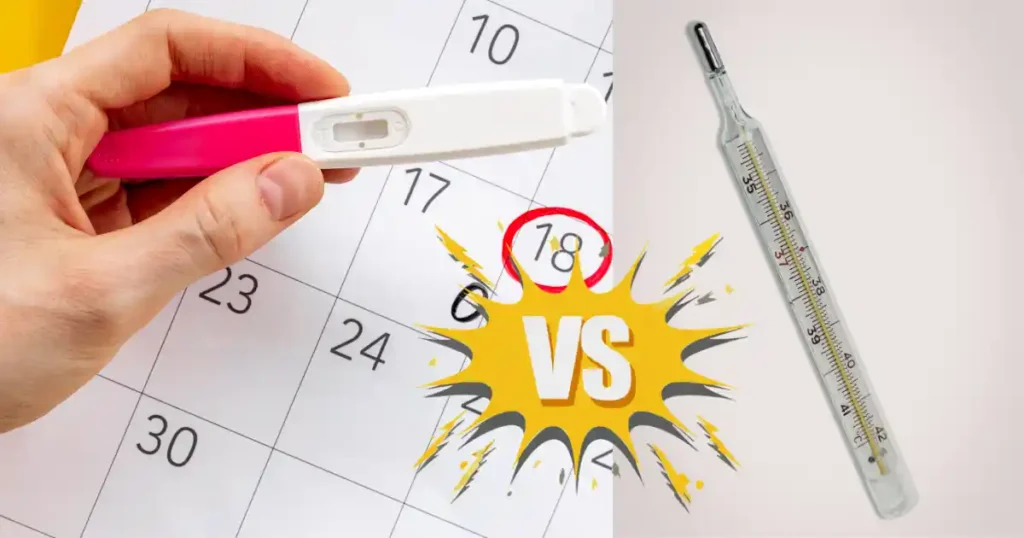
Comparing an ovulation calculator vs basal body temperature was a turning point in how I understood fertility tracking. For months, I trusted an app’s calendar prediction completely. Then I added a basal thermometer. Within two cycles, my BBT chart showed that my actual ovulation was consistently happening two days after the app predicted. That two-day discrepancy sounds small. For someone trying to conceive, it meant consistently timing intercourse outside the peak fertile window. Once I understood the fundamental difference between what each method measures and what each one cannot do, everything about my tracking strategy became sharper and more reliable. This guide explains both tools completely so you can choose the right combination for your situation.
Understanding Ovulation Tracking Tools
Many trying-to-conceive couples wonder which method gives the clearest insight. The answer depends on what question you need answered.
What Is an Ovulation Calculator
An ovulation calculator is a digital tool that estimates your fertile window using historical cycle data. You enter your average cycle length and your last period date. The calculator subtracts 14 days from your cycle length to predict your ovulation day and marks the surrounding five to six days as your fertile window.
Calculators are simple, free, and require no equipment. They are best suited for people with regular, consistent cycles and as a starting estimate to guide when to begin more specific tracking methods. They predict when ovulation is expected to occur based on past cycle averages.
The critical word is “estimates.” A calculator applies a formula to your cycle history. It does not measure anything happening in your body in the current cycle. That distinction defines where it excels and where it falls short.
What Is Basal Body Temperature Tracking
Basal body temperature (BBT) is your body’s lowest resting temperature, recorded every morning before any activity. BBT has been used as a fertility awareness tool for over 100 years. The relationship between a temperature rise and ovulation, and the use of a charted single oral temperature recording taken first thing upon waking to retrospectively determine the presence and timing of ovulation was reported in the literature over 100 years ago.
The physiological basis is progesterone. Shortly after ovulation, progesterone released from the corpus luteum causes BBT to increase an estimated 0.5 to 1 degree Fahrenheit throughout the luteal phase. Average basal body temperature during the follicular phase before ovulation averages between 97.0 and 98.0 degrees Fahrenheit. After ovulation, it rises and stays elevated until just before menstruation.
BBT confirms that ovulation has already happened. It does not predict ovulation in advance. That retrospective function is its most important and most commonly misunderstood characteristic.
A Real-Life Scenario
Using a calculator in Portland, Oregon and thinking I understood my ovulation timing was a comfortable illusion I held for several cycles. When I finally added BBT tracking, the chart revealed something the app never showed me. My follicular phase was consistently two days longer than average in high-stress months. That shift was invisible in my calculator’s output, which applied the same formula every month regardless of what was happening. My BBT chart made the shift visible in real time. It showed the temperature rise arriving later than the calculator had predicted, and that information changed when I timed intercourse in those cycles.
How Ovulation Calculators and BBT Work
Understanding the mechanics of each tool sets realistic expectations for what each one can and cannot deliver.
Ovulation Calculator Mechanics
Every calculator starts with two inputs: your last period start date and your average cycle length. From those, it applies the subtract-14 formula to estimate ovulation day and builds your predicted fertile window around that estimate.
The prediction accuracy depends entirely on how closely your current cycle follows your historical average. For regular cycles with minimal variation, this correlation is reasonable. For cycles affected by stress, illness, or lifestyle changes, the current cycle diverges from the average while the calculator’s output does not.
More advanced apps integrate BBT readings, OPK results, and cervical mucus observations. When those physiological data points are consistently logged, the app’s predictions improve because they are no longer based only on calendar math. The best calculator-based apps function as data hubs that combine multiple signals into a refined prediction.
BBT Mechanics
BBT tracking requires a basal thermometer that measures temperature to at least one-tenth or two decimal places of a degree. Standard oral thermometers are not sensitive enough to capture the subtle 0.5 to 1-degree Fahrenheit rise that ovulation produces. Take BBT immediately upon waking, before getting out of bed, speaking, or consuming anything. Record the temperature daily in a chart or tracking app.
Over multiple cycles, a biphasic pattern emerges. Temperatures are consistently lower during the follicular phase before ovulation and consistently higher during the luteal phase after it. The shift from low to high temperatures marks the ovulation event and confirms it occurred. Ideally, charting the daily basal body temperature will show a noticeable increase of approximately 0.5 to 1 degree Fahrenheit shortly after ovulation. This increase then sustains until the start of menstruation.
Crucially, the temperature rise confirms ovulation after it has already happened. By the time the chart shows the rise, ovulation is complete. BBT gives you retrospective confirmation and, over multiple cycles, a personal pattern that helps you anticipate when ovulation will likely fall in future cycles.
Expert Insight
“BBT gives a physiological signal of ovulation, while calculators provide a calendar-based estimate,” says Dr. Jessica Shepherd, a Dallas, Texas-based board-certified OB-GYN and FACOG, founder of Sanctum Med and Wellness, Chief Medical Officer of Hers, and author of Generation M: Living Well in Perimenopause and Menopause. Dr. Shepherd completed her residency at Drexel University College of Medicine and a fellowship in Gynecologic Endoscopy and Minimally Invasive Surgery at the University of Louisville. She serves on the Advisory Board for Women’s Health Magazine and Women’s Health.org, and is a regular contributor on Good Morning America and The Today Show.
Her distinction captures the essential difference between the two methods. The calculator estimates what will happen based on the past. BBT records the physiological reality of what is happening now.
Accuracy Comparison Between Calculator and BBT
Each method has specific accuracy strengths and specific failure modes. Understanding both is what makes you a more effective tracker.
Ovulation Calculator Accuracy
For regular cycles with minimal variation, calendar-based calculators provide useful fertile window estimates. The performance drops significantly for irregular cycles or cycles affected by lifestyle disruption.
Research examining multiple calendar-based fertility apps found their average accuracy for predicting the actual fertile window to be approximately 19 to 22 percent. That is the category average, not a best-case scenario. Individual accuracy can be higher for users with very consistent cycles and several months of logged data, but the population-level performance of calendar tools is substantially lower than most users assume.
Calculators also cannot confirm whether ovulation actually occurred. A predicted fertile window that falls during a cycle where ovulation was delayed by stress or illness will appear identical on the calculator to a cycle where ovulation happened exactly on schedule. The calculator has no mechanism to distinguish between those two situations.
BBT Accuracy
BBT is the standard retrospective confirmation method for ovulation. It detects whether ovulation occurred in a given cycle, and it does so with meaningful accuracy when properly measured.
In a study of 30 normally menstruating women correlating BBT to serum LH, progesterone, and estradiol levels, 70 percent of subjects showed a biphasic BBT that correlated with an ovulatory hormonal pattern. However, in approximately 20 percent of ovulatory cycles, BBT failed to demonstrate a clear biphasic pattern even when ovulation had occurred hormonally. That is an important limitation: BBT does not confirm ovulation in 100 percent of cycles, even when performed correctly.
BBT is strongly affected by external variables. Illness, alcohol, travel across time zones, a night of disrupted sleep, or measuring at a significantly different time than usual can all alter the temperature reading enough to distort the chart. Accurate results are dependent on consistent measurements every morning at the same time before any activity.
Accuracy Comparison Table
Here is a clear, side-by-side view of how each method performs across the most important tracking dimensions.
| Feature | Ovulation Calculator | Basal Body Temperature |
|---|---|---|
| Type of output | Calendar-based estimate of future ovulation | Physiological confirmation of past ovulation |
| Overall accuracy | Low to medium (approximately 19% for apps) | High for confirming ovulation when clear biphasic pattern present |
| Handles cycle irregularity | Reduced accuracy, not adaptive | Detects ovulation whenever it occurs, chart may be harder to interpret |
| Predicts ovulation in advance | Yes, estimate only | No, confirms retrospectively |
| Confirms ovulation occurred | No | Yes, when clear thermal shift visible |
| Affected by lifestyle factors | Indirectly, through cycle length | Directly, illness, alcohol, poor sleep alter readings |
| Cost | Free to low cost | Very low, only a basal thermometer required |
| Learning curve | Minimal | Moderate, takes 2 to 3 cycles to learn to read |
Advantages and Limitations of Each Method
An honest view of both methods helps you choose the right combination for your tracking goals.
Ovulation Calculator Advantages
Calculators are free, instantly available, and require no equipment or daily commitment. Setup takes under two minutes. The output is immediately understandable. They provide a framework for when to begin OPK testing or closer physical observation each cycle, which reduces per-cycle costs significantly compared to testing from cycle day one.
For someone building cycle awareness for the first time, a calculator is the right first step. It creates the historical cycle length data that all more advanced tracking methods benefit from.
Ovulation Calculator Limitations
Calculators cannot measure anything happening in the current cycle. They apply historical averages without the ability to detect stress-driven ovulation delay, anovulatory cycles, PCOS-related hormonal disruption, or any other real-time cycle variation. The prediction stays the same regardless of what your biology is doing that month.
For irregular cycles, the gap between prediction and actual ovulation timing can be five to ten days. For PCOS, the calculator’s prediction may consistently miss the LH surge window. For anyone who has been tracking for several months and consistently notices that their actual fertile signs arrive outside the predicted window, this limitation is the most likely explanation.
BBT Advantages
BBT is the most affordable confirmation method available for detecting whether ovulation occurred. The only required equipment is a basal thermometer, which costs between $10 and $25. The data is generated every morning as part of your existing waking routine.
Over multiple cycles, BBT charts reveal luteal phase length, which is more consistent than the follicular phase and provides a personalized window for when to take a pregnancy test. Charts also reveal trends: cycles where ovulation was delayed show the temperature rise arriving later than usual. Anovulatory cycles show a flat chart with no sustained temperature rise.
BBT can detect cycle irregularities that a calculator would never flag because it is measuring a real physiological event rather than applying a formula.
BBT Limitations
BBT is retrospective. By the time the chart shows the temperature rise, ovulation has already occurred. The fertile window is largely closed. For conception timing, BBT works as a pattern-building tool across multiple cycles rather than a same-cycle advance warning.
External factors affect readings significantly. Any disruption to normal sleep, including a late night, alcohol, illness, or even taking your temperature at a different time than usual, can produce a false spike or suppress the normal rise. Strict consistency is the non-negotiable requirement for reliable BBT data. BBT is influenced by so many factors, from sleepless nights to travel to irregular periods and stress, which is why it should not be used as a sole method.
The learning curve is steeper than a calculator. Reading a biphasic chart accurately takes two to three cycles of practice before the pattern becomes clearly recognizable for most users.
A Real-Life Insight
BBT tracking felt tedious at first. Taking my temperature before I even sat up, every single morning, seven days a week, felt like an inconvenient ritual. Then, after two months, I could look at my chart and see my ovulation timing with clarity that no app prediction had ever given me. My calculator showed day 14 every month. My chart showed that I ovulated on day 16 in shorter cycles and day 19 in longer ones. That personal pattern was my real data. The tedium produced genuine insight.
Combining Ovulation Calculators and BBT for Best Results
The most accurate fertility tracking combines the forward-looking estimate of a calculator with the retrospective physiological confirmation of BBT.
Step 1: Use a Calculator to Estimate Your Fertile Window
Start with at least three months of logged period data in a cycle tracking app. Use the calculator’s predicted fertile window as your framework for the current cycle. This tells you approximately when to start watching for physical signs and when to begin OPK testing.
The calculator’s estimate is your starting point, not your answer. It narrows the window for more targeted testing. That is its most useful function in a combined strategy.
Step 2: Confirm Ovulation with BBT
Take your temperature every morning at the same time before any activity. Use a dedicated basal thermometer, not a standard one. Chart the readings daily in your tracking app or on a paper chart.
Track BBT for two to three cycles before drawing conclusions. The first cycle provides a baseline. The second reveals your personal ovulation timing pattern relative to cycle day. The third cycle confirms whether that pattern is consistent or variable. After you notice a trend showing your temperature rises about midway through your cycle, you know your most fertile window is about three to five days before that temperature rise happens.
Step 3: Track Physical Symptoms Alongside
Add cervical mucus observation daily from the end of your period. The shift from dry or creamy to clear and stretchy signals rising estrogen and approaching ovulation in real time. Add OPK strips to detect the LH surge biochemically in the days around your expected fertile window.
These three layers, calculator for the estimate, BBT for retrospective confirmation, and cervical mucus plus OPK for real-time detection, together give you the most complete picture available from home-based tracking.
Practical Tip
Combining both methods significantly reduces guesswork. The calculator tells you when to start watching. The OPK tells you when the surge is actually happening. The BBT tells you whether ovulation followed. Cervical mucus tells you what your estrogen is doing between those events. Each tool answers a different question, and together they remove the gaps that any single method leaves open.
Common Mistakes Users Make
These errors affect both tools and are easy to correct once identified.
Mistake 1: Relying Only on the Calculator
Calendar apps produce estimates that are wrong for most users in most cycles when compared to actual ovulation timing. Using a calculator alone for conception planning misses the real-time biological information that determines where the actual fertile window falls this month.
The fix is to add BBT tracking for retrospective confirmation and OPK strips for real-time advance warning. Both together give you information the calculator cannot provide.
Mistake 2: Inconsistent BBT Measurement
BBT requires strict morning consistency. Testing at 6:30 AM on weekdays but 8:30 AM on weekends introduces measurement variability that looks like temperature changes in the chart when it is actually just measurement timing variation. Set an alarm at the same time seven days a week. Keep your thermometer on your nightstand. Measure before any movement.
Mistake 3: Ignoring Environmental Factors
Alcohol the night before, a fever, a flight across two time zones, or even sleeping with an electric blanket can raise BBT significantly. That artificially elevated reading, if it falls in the expected ovulation window, can look like a post-ovulatory rise when it is not. Note any environmental disruptions in your tracking app alongside the temperature reading. Flagged readings can be excluded or interpreted with context rather than treated as reliable data points.
Mistakes and Corrections Reference Table
Here is a clear summary of the most common BBT and calculator tracking mistakes and how to fix each one.
| Mistake | Effect | How to Fix |
|---|---|---|
| Using calculator alone | Missed fertile window without real-time confirmation | Add OPK strips and cervical mucus observation |
| Inconsistent BBT timing | Artificial temperature variation obscures ovulation pattern | Set daily alarm at the same time, test before movement |
| Ignoring lifestyle disruptions | False temperature spikes misread as ovulation confirmation | Log illness, alcohol, travel alongside readings and adjust interpretation |
Choosing the Right Method for You
The best approach depends on your cycle regularity, your willingness to commit to a daily habit, and your fertility goals.
Factors to Consider
For regular cycles and general fertile window awareness, a calculator plus OPK strips is a low-cost, effective starting combination. BBT adds a confirmation layer that is most valuable for users who want to understand their personal ovulation timing pattern in detail, detect luteal phase inadequacy, or track cycles over several months to build a personal baseline.
For irregular cycles, BBT is more valuable than a calculator because it responds to when ovulation actually occurs in any given cycle, not when past averages predict it should. For couples who have been trying to conceive for several months without success, adding BBT to the tracking strategy often reveals information, like a delayed thermal shift or a flat chart, that a calculator would never flag.
Recommended Tools
For BBT, use a digital basal thermometer that measures to at least two decimal places. The iProven BBT-120, Easy@Home BBT thermometer, and Femometer Smart Basal Thermometer are all widely used and affordable. Smart thermometers like the Tempdrop, worn as a wrist sensor during sleep, record temperature continuously and automatically, removing the need for strict morning timing.
For calculators and chart logging, apps like Clue, Flo, and Natural Cycles allow BBT, OPK results, and cervical mucus to be logged alongside period dates for integrated tracking and pattern visualization.
Expert Advice Restated
Dr. Jessica Shepherd’s clinical framing is the most practically useful orientation for this decision: calculators give a calendar estimate; BBT gives a physiological signal of ovulation. For beginners, the calculator is the right starting point. For anyone who wants confirmation of whether ovulation is actually occurring and when, BBT is the tool that answers that question directly in a way no formula can.
QA About Ovulation Calculators and BBT
Can I Rely Only on a Calculator
Only for general cycle awareness. For conception planning, calendar calculators have average population-level accuracy of approximately 19 to 22 percent for predicting the actual fertile window. For irregular cycles, that accuracy drops further. Pair any calculator with at least one real-time detection method.
Is BBT Tracking Difficult
It requires daily commitment and strict consistency but is not technically difficult. The main challenge is building the habit of measuring at exactly the same time every morning before any activity. Once the habit is established, the process takes under two minutes per day. The learning curve for reading charts accurately takes two to three cycles.
Can Both Be Used Together
Yes. This is the recommended approach for most fertility tracking goals. The calculator predicts when the fertile window is likely to fall. BBT confirms whether ovulation occurred and, over multiple cycles, reveals your personal ovulation timing pattern. OPK strips fill the gap between them by providing real-time advance warning during the cycle.
How Long Should I Track My Cycle
A minimum of three cycles for pattern recognition from either method. Cleveland Clinic recommends tracking BBT for at least three menstrual cycles to find your pattern. For irregular cycles or PCOS, six cycles of consistent multi-method tracking gives a more reliable picture of personal ovulation timing and the factors that influence it.
Practical Tips for Effective Fertility Tracking
Consistent daily habits are the foundation of reliable data from both methods.
Track Daily and Be Consistent
Log BBT every morning at the same time without exception. Record OPK results daily during your testing window. Note cervical mucus texture and cervical position every day from the end of your period. Log your period start date immediately when it arrives. Consistent daily input produces the pattern that makes both methods useful.
Combine Methods for Maximum Accuracy
Calculator for timing context, OPK for biochemical LH surge detection, BBT for post-ovulatory confirmation, and cervical mucus for continuous real-time estrogen signaling. Each method fills a gap the others leave open. None of them reaches full usefulness in isolation.
Patience and Observation Are Foundational
Fertility tracking takes cycles to fully understand. One confusing chart is not a diagnosis. One calculator prediction that missed your actual surge is not evidence the method is useless. Three cycles of consistent, multi-method data reveal patterns that transform both tools from confusing to genuinely clarifying. After combining a calculator and BBT over five months, many people describe a turning point where cycle variability became understandable rather than alarming. That clarity is worth the effort of building the tracking habit.
Final Recommendation
Choosing between an ovulation calculator vs basal body temperature is not a binary decision. From personal experience and from studying the research carefully, the most effective approach is to use both tools for what each does best. Start with a free calculator app and log your period start dates for three months to build your personal cycle length baseline. Then add daily BBT tracking.
Use the calculator’s predicted window to set your OPK testing start date. Use BBT to confirm that ovulation occurred and to build your personalized ovulation timing pattern over two to three cycles. Never rely on the calculator alone for conception timing, as its average population-level accuracy is approximately 19 to 22 percent for predicting the actual fertile window. Never rely on BBT alone for advance warning, as the temperature rise arrives after ovulation, not before it.
Add OPK strips during the predicted window to get the real-time biochemical advance warning that both the calculator and BBT cannot provide in the same cycle. If after three to six months of combined tracking your BBT charts show no clear biphasic pattern, or your OPKs never produce a clear positive surge, book an appointment with a gynecologist or reproductive endocrinologist. Your organized tracking data from those months gives that conversation an immediately productive and well-documented starting point.
FAQs
What is the difference between ovulation calculator vs basal body temperature?
Ovulation calculator vs basal body temperature differs in approach. A calculator predicts fertile days, while BBT tracks temperature changes to confirm ovulation after it occurs.
Which is more accurate: ovulation calculator vs basal body temperature?
Basal body temperature is more accurate for confirming ovulation. Ovulation calculator vs basal body temperature shows calculators estimate, while BBT reflects real body changes.
How does ovulation calculator vs basal body temperature tracking work?
An ovulation calculator vs basal body temperature works differently. The calculator uses cycle dates, while BBT measures daily morning temperature shifts to detect ovulation timing.
Can I rely on ovulation calculator vs basal body temperature alone?
You can use either, but combining both is better. Ovulation calculator vs basal body temperature together gives estimates plus confirmation, improving overall cycle awareness.
Which is easier to use: ovulation calculator vs basal body temperature?
An ovulation calculator is easier and faster. Ovulation calculator vs basal body temperature differs, as BBT needs daily tracking and consistency to be useful.
Is ovulation calculator vs basal body temperature better for irregular cycles?
Basal body temperature can be more helpful for irregular cycles. Ovulation calculator vs basal body temperature shows BBT adapts to real patterns, while calculators may be less precise.
Should beginners choose ovulation calculator vs basal body temperature?
Beginners often start with an ovulation calculator. Ovulation calculator vs basal body temperature can then be added later for deeper tracking and better ovulation confirmation.