
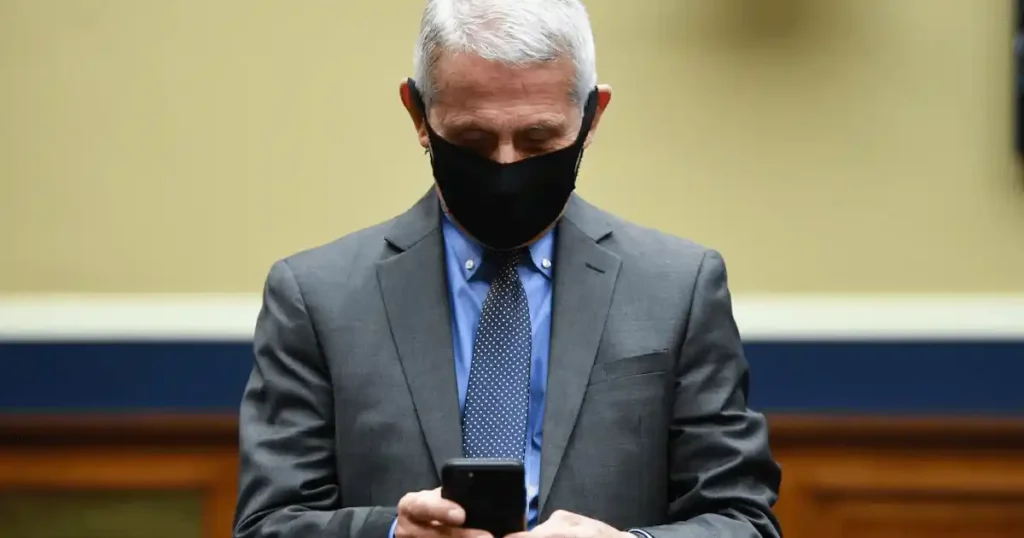
WASHINGTON — A newly disclosed collection of government phone records has revealed internal conversations between top federal health leaders during the early stages of the nationwide immunization rollout. Two prominent Republican lawmakers made the first batch of archived messages public on Monday, highlighting conversations about vaccine safety and pregnancy from early 2021.
The documents were released by Senator Ron Johnson of Wisconsin and Senator Rand Paul of Kentucky. Both lawmakers lead congressional panels examining federal decision-making during the global health crisis. The records come from a backup of the government-issued smartphone used by Dr. Anthony S. Fauci, who served for decades as the nation’s leading infectious disease specialist before retiring from public service in late 2022.
Examining the Early Message Exchanges
The shared message records date back to January 2021, a period when vaccines were first becoming available to healthcare workers and vulnerable populations. In the messages, Dr. Fauci discussed possible biological reactions with other senior health advisers.
The exchange specifically noted that strong post-vaccination immune responses, such as high fevers or cytokine reactions after a second shot, could theoretically present a risk during the first trimester of pregnancy. Rochelle Walensky, who served as the director of the Centers for Disease Control and Prevention (CDC) at the time, replied that the point was worth considering, particularly following second doses.
Congressional investigators compared these early private discussions with later public statements made by health agencies. In subsequent weeks and months, federal representatives stated that monitoring systems had not identified unusual safety concerns among pregnant women and emphasized that the overall benefits of vaccination outweighed the known dangers of contracting the virus.
By August 2021, the CDC formally urged pregnant individuals to receive the immunization. The agency based its recommendation on extensive clinical tracking that showed no elevated rate of pregnancy loss among vaccinated individuals compared to baseline numbers.
The Scientific Context Around Pregnancy Data
Medical experts and former agency advisers point out that early message exchanges reflect standard scientific dialogue during a period when clinical data was still developing. When pharmaceutical manufacturers carried out initial clinical trials for the shots, pregnant women were excluded from participation, which is a standard historical practice in drug development.
Because expectant mothers were not included in early trials, researchers had to rely on real-world observation as the rollout widened. At the same time, hospital data quickly showed that pregnant women who caught the virus faced much higher chances of severe illness, premature labor, and intensive care admissions.
Subsequent studies published in peer-reviewed journals, including the New England Journal of Medicine, analyzed outcomes across thousands of pregnancies. Those extensive evaluations revealed no unusual safety issues. Major medical groups, including the American College of Obstetricians and Gynecologists alongside the Society for Maternal-Fetal Medicine, strongly advised expectant mothers to get protected, noting that the proven hazards of severe viral infection far exceeded the theoretical risks of immunization.
Global monitoring across more than one million vaccinated pregnant women has continued to confirm that the shots do not increase the incidence of stillbirth, birth defects, or early pregnancy loss.
Scope of the Congressional Record Review
The newly shared messages represent a tiny fraction of a massive archive recovered from the former official device. Senate investigators reported that the files contain more than 34,000 text communications and 522 recorded voicemails.
The Department of Health and Human Services (HHS), now operating under new administrative leadership, provided the smartphone data and digital diary archives to congressional oversight panels. Committee leaders stated that the disclosure marks the beginning of an expanded series of inquiries into historical health policies, internal communications, and pandemic management strategies.
Dr. Fauci declined to provide public commentary regarding the released mobile records. Other former advisers named in the communications did not immediately issue statements regarding the disclosure.
Political Reactions and Regulatory Shifts
The document release occurs amid broader political and regulatory debates concerning national immunization guidelines. Lawmakers leading the investigative panels have raised repeated questions about the speed of public safety disclosures, arguing that any early theoretical concerns should have been shared immediately with the public.
Meanwhile, federal health agencies are experiencing significant policy shifts. National leadership has recently reviewed standard immunization schedules, questioning longstanding recommendations for both adults and children.
Despite changing political debates, major medical societies continue to support established immunization guidance. Professional physician groups maintain that vaccines remain one of the most effective tools for preventing severe illness, hospitalization, and maternal health complications.
Why It Matters
The release of these Anthony Fauci text messages highlights the delicate balance between private scientific deliberation and clear public health guidance during times of crisis. When health authorities weigh theoretical biological mechanisms against emerging real-world data, the timing and transparency of their announcements directly impact long-term public trust. For patients and healthcare providers, having full visibility into past safety deliberations helps demystify how clinical recommendations are created. As congressional panels continue reviewing thousands of additional messages, these inquiries will likely shape future standards for federal transparency, regulatory oversight, and pandemic preparedness policies.
Sources / References
- United States Senate Permanent Subcommittee on Investigations – Official Document Release and Records Repository.
- Centers for Disease Control and Prevention (CDC) – Maternal and Infant Health Clinical Guidance and COVID-19 Safety Data.
- The New England Journal of Medicine – “Preliminary Findings of mRNA Covid-19 Vaccine Safety in Pregnant Persons.”
- American College of Obstetricians and Gynecologists (ACOG) & Society for Maternal-Fetal Medicine (SMFM) – Joint Clinical Practice Guidelines.