If your calculator says Tuesday but your body says Thursday, the calendar does not get the final vote. A basic calculator gives you a projected date, but your body does not always follow an automated schedule. Looking for the best ovulation calculator replacement comes down to your personal goal. You might want to learn cycle patterns, identify physical signs, or get custom tracking. Calendar tools estimate timing based on math; they do not measure real physical markers.
The American College of Obstetricians and Gynecologists (ACOG) describes several effective fertility-awareness approaches, including cervical mucus, BBT, and symptothermal tracking. Back when I lived in Seattle, I learned firsthand that tracking real biological signals beats relying on a static digital guess every single time.
Why Look for an Ovulation Calculator Replacement?
A simple calculator is convenient, but it mainly works from cycle dates and averages. That can be too basic when cycles vary from month to month.
What an Ovulation Calculator Actually Does
Uses:
- Last menstrual period
- Average cycle length
- Estimated cycle pattern
Estimates:
- Next period
- Approximate ovulation day
- Estimated fertile window
Prediction is a mathematical guess based on past averages, while measurement checks real physiological markers. A calendar calculator does not detect a luteinizing hormone (LH) surge or confirm that an egg was actually released.
Why Calendar-Based Predictions Can Miss the Mark
- Ovulation does not necessarily happen on the exact same cycle day every month.
- Cycle length can change naturally over time.
- Stress, illness, travel, sleep changes, and lifestyle factors alter physical timing.
- Clinical research shows wide variation in predicted fertile windows among online calculators.
When a Basic Calculator May Be Too Limited
- Cycles that vary significantly from month to month.
- Recently changing menstrual patterns or postpartum shifts.
- Users who want more than a static date estimate.
- People who want to combine multiple physical signs.
- Users concerned about data privacy and online tracking.
Calculator vs. Real-Time Fertility Signals
- Calculator: Predicts timing from historical cycle math.
- BBT: Records a resting temperature pattern associated with ovulation.
- Cervical mucus: Observes physical fluid changes caused by rising estrogen.
- LH test: Detects a hormone surge in urine before ovulation.
- Combined tracking: Uses more than one physical signal for better context.
What Is the Best Ovulation Calculator Replacement?
The best replacement is usually a fertility tracking method that uses more than calendar dates, rather than another calculator with a different design.
Best Overall: A Multi-Signal Fertility Tracker
Tracks several data points:
- Cycle dates
- BBT
- Cervical mucus
- LH test results
- Physical symptoms
Combining multiple signals provides far more personal context than calendar math alone. However, using multiple signals in an app does not automatically make its automated predictions 100% accurate.
Best Simple Replacement: Period and Cycle Tracking App
Useful for:
- Recording period dates cleanly
- Seeing long-term cycle history
- Spotting personal trends
This option works best for people who want a simple digital record. Keep in mind that a standard period tracker is a logging tool, not a medically validated predictor.
Best Evidence-Based Physical Sign: Cervical Mucus Tracking
Cervical mucus tracking means observing daily fluid changes at the vulva or vaginal opening. As estrogen rises near your fertile window, fluid increases and shifts texture. ACOG notes that cervical mucus tends to become thinner, clearer, and more slippery right before ovulation. Keep in mind that medications, sexual activity, and hygiene products can alter these natural physical observations.
Best Temperature-Based Option: Basal Body Temperature
Basal body temperature (BBT) is your baseline body temperature measured right after waking up before any physical activity. Rising progesterone causes a slight temperature shift after ovulation. ACOG specifically notes that BBT is better at confirming that ovulation likely occurred than predicting it beforehand.
Best Hormone-Based Option: LH Ovulation Tests
Luteinizing hormone (LH) triggers the release of a mature egg. A positive urine LH test indicates that a hormone surge is taking place in your body. ACOG states that an LH surge suggests ovulation may occur within roughly 24 to 48 hours. This real-time biological data is far more direct than calendar math, though a positive test does not guarantee an egg is released.
Ovulation Calculator Replacements Compared
The table below breaks down how popular tracking methods compare across inputs, strengths, and primary limitations. Reviewing these key differences helps you pick the right tool without guessing.
| Method | What It Uses | Main Strength | Main Limitation |
| Ovulation calculator | Cycle dates | Very easy to use | Math estimate only |
| Period tracker | Cycle history | Simple digital records | May rely on calendar math |
| BBT tracking | Body temperature | Helps confirm ovulation | Confirms after the shift |
| Cervical mucus | Physical fertility sign | Real-time body signal | Requires daily observation |
| LH test | Urine LH levels | Detects hormone surge | Does not guarantee egg release |
| Multi-signal app | Several inputs | Custom personal data | Requires effort and data sharing |
Expert note: ACOG explains that different fertility-awareness methods rely on unique physical signals, and BBT alone is not a reliable forward-looking predictor. Collecting more data points does not automatically guarantee more accurate mathematical predictions.
How Fertility Tracking Apps Compare With Ovulation Calculators
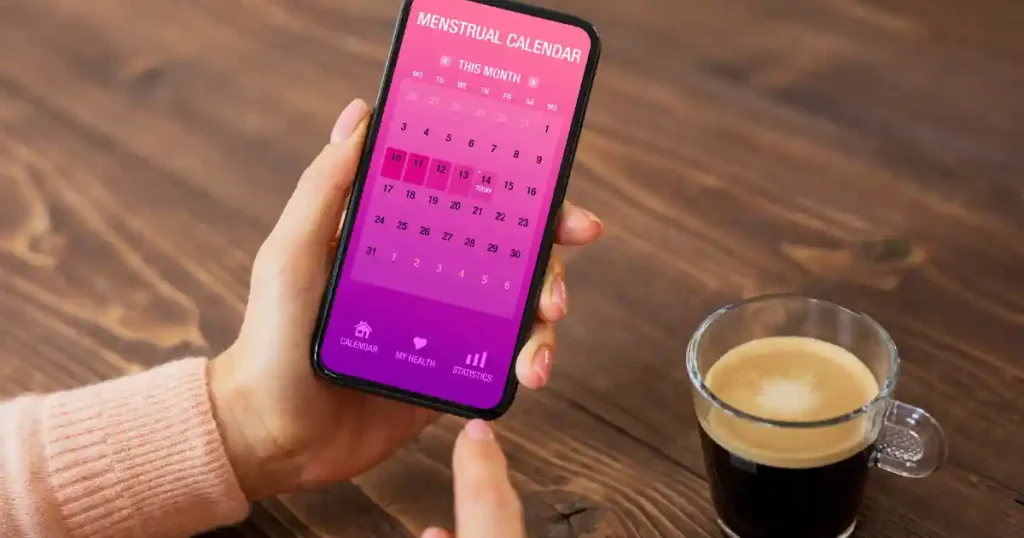
Apps can turn a basic calendar into a richer tracking system, but the label “fertility app” does not tell you exactly how its prediction algorithm works.
Calendar-Only Apps
- Primarily use previous period start dates.
- Offer a simple digital interface.
- Provide limited physical information.
Users should always verify whether an app tracks physical signals or just calculates dates.
Apps That Track BBT
- Allow daily morning temperature entry.
- Identify thermal patterns across cycles.
Manual logging requires a standard digital basal thermometer, whereas connected wearables send daily data automatically.
Apps That Use LH Results
- Record urine ovulation test results.
- Add hormone data to cycle history records.
Logging a real hormone test is far more accurate than guessing an ovulation day from average cycle length.
Multi-Marker Fertility Apps
May combine:
- Period dates
- BBT shifts
- LH test logs
- Cervical mucus
- Daily symptoms
These tools use algorithms to process combined inputs. Users should check if the app clearly explains its underlying method and clinical limitations.
Don’t Judge an App by Its Star Rating Alone
Check these criteria:
- Tracking inputs allowed
- Core prediction method
- Clinical evidence
- Clear privacy policy
- Medical disclaimers
- Independent research support
Research shows that fertility apps vary widely in the tracking methods and accuracy information they provide.
Best Ovulation Calculator Replacement by Your Goal
Not everyone needs the same tracking setup. Someone who wants a simple cycle diary needs a very different tool from someone tracking physical signs.
If You Want the Simplest Option
Choose: Basic period tracking.
- Requires minimal daily effort.
- Helps you learn basic cycle patterns.
- Does not confirm exact ovulation timing.
If You Want to Understand Your Body Better
Choose: Cervical mucus + cycle tracking.
- Adds a direct physical fertility sign.
- Provides real-time context that dates cannot give.
If You Want to Confirm a Pattern
Choose: BBT tracking.
- Useful for reviewing post-ovulation temperature changes.
- Temperature shifts confirm ovulation after it occurs.
If You Want a Hormone Signal
Choose: LH urine testing.
- Tracks real-time luteinizing hormone surges.
- Useful when a calendar estimate feels too broad.
If You Want Everything in One Place
Choose: Multi-signal fertility tracking.
- Combines dates, mucus, BBT, and tests.
- Offers detailed personal insights.
- Requires consistent daily data entry.
If Your Cycles Are Highly Irregular
Choose: Professional medical guidance.
- Calendar formulas fail when cycle length shifts.
- ACOG notes that highly irregular cycles make prediction difficult and warrant advice from an ob-gyn or specialist.
Features to Look for in an Ovulation Calculator Replacement
A good replacement tool should do far more than put a fresh color scheme on a simple calendar formula.
Multiple Tracking Inputs
Look for support for:
- Period start dates
- Overall cycle length
- Morning BBT readings
- Cervical mucus observations
- LH test results
- Physical symptoms and notes
Clear Prediction Method
- Does the tool explain how it estimates fertile days?
- Does it distinguish rough estimates from real measured signals?
- Does it explain scientific uncertainty clearly?
- Does it avoid making impossible promises about pregnancy?
Irregular-Cycle Support
- Allows adjustable cycle history limits.
- Supports varying cycle lengths without error messages.
- Uses flexible fertile-window estimates instead of rigid dates.
Privacy and Data Controls
- What personal health information does the tool collect?
- Does it sell or share information with third parties?
- Can users permanently delete their account and data?
- Is the privacy policy clear and easy to read?
ACOG recommends checking how fertility apps store and share personal data, noting that these consumer apps are generally not covered by HIPAA laws.
Evidence and Regulatory Claims
- Look for transparent clinical evidence.
- Do not confuse “FDA registered” or “FDA listed” with clearance.
- Verify contraception claims directly on the FDA database.
- The FDA classifies digital contraception software under specific medical-device categories.
What Makes a Fertility Tracking Tool More Useful Than a Calculator?
Data depth is the biggest upgrade. A calculator starts and ends with the calendar, while a true tracking system incorporates real physical signals.
Calendar Data
- Period start dates
- Average cycle length
- Past historical patterns
Physiological Data
- Morning BBT trends
- Cervical mucus observations
- Urine LH test results
Personal Pattern Recognition
- Compare multiple cycles side by side.
- Spot subtle body changes easily.
- Record unusual physical factors.
- Avoid assuming one odd cycle is your new normal.
Human Judgment Still Matters
Software processes entered data points. It cannot replace a clinical assessment by a doctor. A digital prediction should always be treated as general information, not a guarantee.
Ovulation Calculator vs Fertility Tracker vs LH Test
This comparison details how each major tool works, what data it relies on, and its core operational requirements. Use it to match your tracking setup to your routine.
| Feature | Calculator | Fertility Tracker | LH Test |
| Uses period dates | Yes | Yes | No |
| Uses historical patterns | Usually | Often | No |
| Tracks BBT | Usually no | Some do | No |
| Tracks cervical mucus | Usually no | Some do | No |
| Detects LH surge | No | Only if entered | Yes |
| Requires daily tracking | Low | Moderate to high | Test-dependent |
| Directly measures LH | No | Not usually | Yes |
| Confirms ovulation | No | Depends on data | No, not alone |
Expert context: These tools answer entirely different questions. A calculator asks, “Based on history, when might ovulation happen?” An LH test asks, “Is there a hormone surge right now?” BBT asks, “Does my temperature pattern show ovulation already happened?”
How to Choose the Right Ovulation Calculator Replacement
Follow these steps to find a fertility tracking approach that fits your life.
Step 1 — Decide What You Actually Need
Ask yourself:
- Do I only want clean cycle records?
- Do I want simple fertile-window estimates?
- Do I want to track physical body signs?
- Do I want real hormone test information?
- Do I want to combine multiple signals together?
Step 2 — Check How the Tool Makes Predictions
- Calendar algorithm alone
- BBT thermal shift tracking
- LH test logging integration
- Cervical mucus observation inputs
- Multi-signal combination model
Step 3 — Check How It Handles Uncertainty
Choose tools that use clear terms like “estimate,” “likely window,” or “fertile range” instead of making rigid, absolute claims.
Step 4 — Review Privacy Before Entering Sensitive Data
- Read the full privacy policy.
- Check third-party data-sharing terms.
- Confirm account and data deletion options.
- Consider what information is truly necessary to log.
Step 5 — Match the Tool to Your Cycle Pattern
- Regular cycles: Simple tracking tools may be enough for pattern awareness.
- Variable cycles: Calendar-only predictions become far less useful.
- Major cycle changes: Seek professional guidance from a healthcare provider.
USA Expert Advice on Replacing an Ovulation Calculator
Relying on clinical expertise ensures you focus on physical signals rather than computer algorithms.
What Dr. Barry Witt Recommends About Ovulation Timing
Dr. Barry Witt, an ob-gyn and reproductive endocrinologist featured in ACOG educational materials, emphasizes learning individual menstrual-cycle patterns and tracking cervical mucus changes. ACOG’s expert guidance notes that there is no single foolproof way to calculate fertile days from a calendar alone.
Expert Point: Don’t Turn Fertility Tracking Into a Stress Test
- Tracking every single metric is not always better.
- Entering too much daily data can create unnecessary anxiety.
- ACOG expert guidance warns that fertility trackers can create stress around trying to track everything perfectly.
When Expert Help Makes More Sense Than Another App
- Highly irregular or missing periods.
- Sudden, significant shifts in cycle patterns.
- Concerns about whether ovulation is taking place.
- Difficulty conceiving after months of trying.
- Physical symptoms that require medical evaluation.
Real-Life Example: Why a Calculator Can Feel Confusing
Seeing how these tools perform in real life makes their differences easy to understand.
A Typical Calendar-Tracking Day
You open an app with your morning coffee. The app predicts your fertile window will start in four days based on your past averages. However, travel, a stressful work week, or poor sleep delays your body’s timing. Your cycle did not sign a contract with your calendar, leaving you with an inaccurate estimate.
What a Multi-Signal Approach Adds
- Period history provides long-term context.
- Cervical mucus gives a real-time physical signal.
- BBT confirms the post-ovulation temperature rise later on.
- LH test strips show the hormone surge taking place.
Using multiple signals clarifies why each tool has a distinct role to play in your routine.
Keep the Tone Human
Life happens. A late shift at work, flu season, or an early morning flight can throw off a temperature reading. Missing a day of tracking is completely fine; your body provides clues continuously throughout your cycle.
Common Mistakes When Replacing an Ovulation Calculator
Mistake 1 — Assuming Every App Predicts Ovulation the Same Way
Apps use different algorithms, ask for different inputs, and define fertile windows differently.
Mistake 2 — Treating an Estimated Date as a Confirmed Date
A calendar prediction is an educated guess, not physical proof that an egg was released.
Mistake 3 — Using BBT as a Forward-Looking Predictor
BBT confirms that a temperature shift occurred after ovulation; it does not predict ovulation in advance.
Mistake 4 — Ignoring Privacy Practices
Fertility data is personal. Always read data-sharing policies before logging details.
Mistake 5 — Assuming More Features Mean Better Accuracy
A long list of app features does not guarantee better underlying science.
Mistake 6 — Using Fertility Tracking as a Substitute for Medical Care
Tracking tools organize personal data, but they cannot diagnose hormonal conditions or infertility.
Privacy and Safety When Using Fertility Tracking Tools
Protecting your personal health data should always be a top priority when choosing digital tools.
What Data Might a Fertility App Collect?
- Period dates and cycle length
- Daily physical symptoms
- Sexual activity records
- Pregnancy test updates
- Morning temperature readings
- Device location and user identifiers
Questions to Ask Before Using an App
- Who owns the entered data?
- Is personal information shared with advertisers?
- Can you request full data deletion?
- Does the company publish clear security practices?
- What happens to data if the company is sold?
Don’t Confuse a Fertility Tool With Medical Care
Consumer apps and calculators are tracking logs, not diagnostic tools. If you have medical concerns, consult a qualified healthcare professional.
Which Ovulation Calculator Replacement Is Right for You?
This decision guide pairs your primary goal with the most effective tracking method for your needs.
| Your Priority | Better Option to Consider | Why |
| Simple cycle tracking | Period tracker | Easy to use with minimal effort |
| Body-based tracking | Cervical mucus tracking | Uses a real physical fertility signal |
| Temperature patterns | BBT tracking | Confirms a post-ovulation shift |
| Hormone signal | LH urine test strips | Directly detects an LH surge |
| Several data points | Multi-signal fertility tracker | Combines physical inputs together |
| Very irregular cycles | Clinician guidance | Calendar math is unreliable |
| Data privacy | Privacy-focused tracker or paper chart | Keeps sensitive data secure |
Short expert note: There is no single “best” replacement for everyone. The right choice depends on whether you value daily simplicity, physical signals, hormone testing, or professional guidance.
FAQ About the Best Ovulation Calculator Replacement
What is the best replacement for an ovulation calculator?
A multi-signal fertility tracker or LH test strips offer more direct biological information than a date calculator, depending on your primary goal.
Are ovulation calculators accurate?
Calculators provide broad estimates based on averages. They cannot predict exact ovulation timing with certainty.
What is more accurate than an ovulation calculator?
Tracking cervical mucus, logging morning BBT shifts, and using urine LH test strips provide direct physical data that beats calendar math.
Is an ovulation app better than a calculator?
Apps store more history and symptoms, but they are not automatically more accurate unless they track real physiological markers.
Can BBT replace an ovulation calculator?
BBT provides valuable physical confirmation of ovulation, but it shifts after ovulation occurs rather than predicting it in advance.
Can an LH test replace an ovulation calculator?
An LH test detects the hormone surge that triggers ovulation, providing a real-time signal that calendar calculators cannot offer.
What is the best ovulation tracking method for irregular cycles?
Calendar tools struggle with variable cycles. Tracking cervical mucus, using LH tests, or consulting an ob-gyn works far better.
Should I use more than one fertility tracking method?
Combining cervical mucus tracking, BBT, and LH testing gives a clearer picture, though it requires more consistent daily effort.
Final Recommendation
Switching to the best ovulation calculator replacement comes down to choosing real physical signals over calendar math. From my years of testing tracking tools, evaluating cycle data, and following ACOG guidelines, I have found that no static calculator can match what your body tells you in real time. If you want a quick cycle diary, a simple period tracker works great. But if you want to identify your fertile window accurately, combine urine LH tests with cervical mucus observations or morning BBT shifts. Always pick privacy-focused tools that keep your personal data secure, and consult an ob-gyn if your cycles are unpredictable.