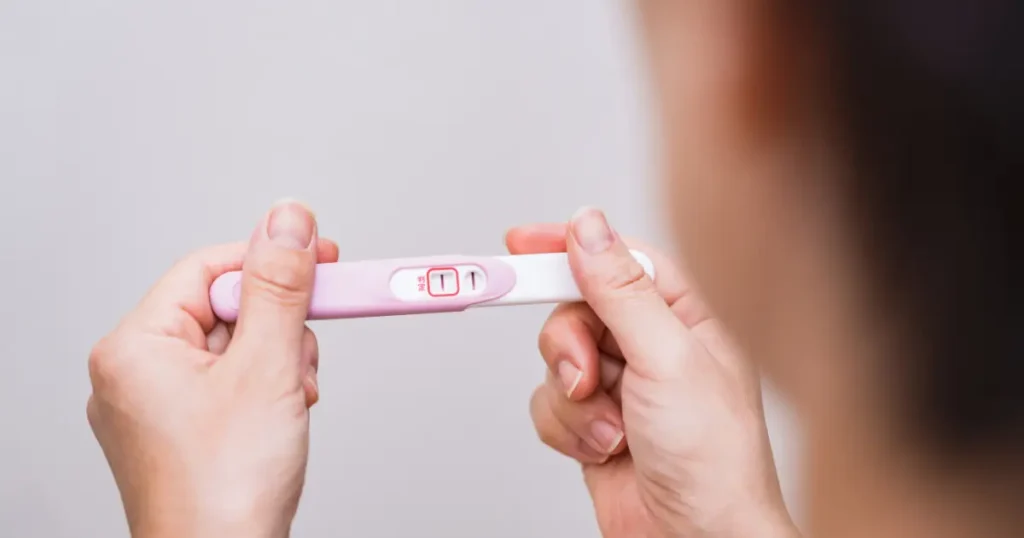
How long does LH stay elevated after ovulation? I started asking that after staring at an ovulation test strip that refused to make up its mind. The line looked dark one day, faded the next, and then showed up faint again a few days later.
Here is the short version. The main LH surge is brief, and it drops fast once the egg leaves. In this guide, I will walk through the timing, what a faint line means, why some tests stay positive, and when high LH may point to something else. Sources vary on exact hours, so I will flag where the numbers differ.
How Long Does LH Stay Elevated After Ovulation? The Quick Answer
The main LH surge usually lasts about 24 to 48 hours in total. It starts roughly 24 to 36 hours before ovulation. After the egg releases, LH falls fast. For most people, it returns to a low baseline within about two days of the peak.
That baseline never drops to zero. A small, steady amount of LH stays in your body through the luteal phase. Exact timing varies from person to person and from source to source, so treat these numbers as typical ranges, not promises.
This article is general education. It does not replace advice from your own doctor.
What LH Does and Why It Surges
LH stands for luteinizing hormone. It plays a big part in getting an egg out of the ovary. Once I understood its job, the strange test lines made more sense.
Where LH Comes From
Your pituitary gland, a small gland in the brain, makes LH. It sends the hormone into your blood in pulses all month long. Near the middle of the cycle, the pulses build into a large surge.
That surge tells the ripe follicle to open and release the egg. This is ovulation. Once the job is done, the pituitary has little reason to keep pushing.
Surge Versus Baseline
Think of LH as a quiet hum with one loud burst. The burst is the surge. The hum is the baseline that comes before and after it.
The table below shows the usual pattern across a cycle.
| Cycle Stage | LH Pattern |
|---|---|
| Early to mid follicular phase | Low and steady |
| Just before ovulation | Sharp rise, called the surge |
| Peak | Highest point, about 12 to 36 hours before ovulation |
| Right after ovulation | Falls fast |
| Luteal phase | Low and steady again |
How LH Works With FSH, Estrogen, and Progesterone
LH never works alone. Three other hormones shape its rise and fall. Seeing the full team helped me stop blaming LH for everything.
The Build-Up Before the Surge
Early in the cycle, FSH, or follicle-stimulating hormone, helps follicles grow. As the lead follicle matures, it makes more estrogen. When estrogen stays high long enough, it signals the pituitary gland to release the LH surge.
That signal explains why the surge arrives only when a follicle is ready. It also explains why stress or illness can sometimes shift the timing of a whole cycle.
The Hand-Off After Ovulation
Once the egg leaves, the follicle becomes the corpus luteum and makes progesterone. Rising progesterone helps keep LH low and its pulses slow. That is one reason LH falls so fast after ovulation.
If the egg is not fertilized, the corpus luteum fades, progesterone drops, and your period starts. The cycle then resets.
A Timeline of LH Around Ovulation
Timing is where most of the confusion starts. People want one clean number, and the body does not offer one. Still, a typical pattern exists.
| Time Point | What Usually Happens |
|---|---|
| Surge starts | About 24 to 36 hours before ovulation |
| Peak | Roughly 12 to 36 hours before the egg releases |
| Ovulation | The follicle opens and the egg leaves |
| 12 to 24 hours later | The egg’s short life span ends if no sperm meets it |
| 1 to 2 days after the peak | LH drops toward baseline |
Sources do not agree to the hour. One says ovulation comes 28 to 36 hours after the surge begins. Another says it comes 12 to 36 hours after the peak. Both can be true, because “start” and “peak” are different moments.
Why the spread? Bodies differ, surges start fast in some people and slowly in others, and urine tests lag behind blood. I stopped hunting for one magic number and started watching my own pattern.
How Long Does LH Stay Elevated After Ovulation on a Test Strip?
A home ovulation test, also called an OPK, only reads positive when urine LH passes the test’s cutoff. That is not the same as having any LH at all. So the strip tells a shorter story than your blood does.
Most people see a positive result for about one to two days. A few see a positive for only one test. After that, the line fades as LH falls.
Why Your Test Can Stay Positive Longer
Some surges stretch out. Others rise in steps, so the line looks dark, lighter, then dark again. Concentrated urine can also darken a line.
Other reasons exist too. PCOS can raise baseline LH. Perimenopause can raise it as well. Medical News Today notes that people near menopause may have high LH, which makes test results less reliable.
Why You May Only See One Positive
Some fertility specialists point out that the spike can be short. If you test once a day, you can catch the peak on one test and miss the rest. That happened to me more than once, and I assumed the test was broken.
Testing twice a day near your expected window can help. Many brands suggest mid-afternoon to early evening as a good time, but check your own brand’s directions.
Blood Tests Versus Ovulation Strips for LH
Home strips and lab tests both measure LH, but they answer different questions. One gives a yes or no. The other gives a number.
A strip reads positive only above a set cutoff in urine, and that cutoff differs by brand. A blood test measures the amount in your blood at one moment. Doctors sometimes order it with FSH, estrogen, or progesterone when they look into irregular cycles or fertility.
Lab ranges differ from lab to lab, so I would not compare your number to a chart online. Ask your clinic which range their lab uses. A single blood draw can also miss a short surge, so timing matters as much as the result.
Why LH Stays Elevated After Ovulation Longer for Some People
Researchers have described different surge shapes. Some rise fast and fall fast. Others climb in steps or hold a longer, flatter peak. I could not find one source with clean percentages for each shape, so I will keep this general.
A longer shape can make your strip look positive for three or four days. That does not always signal a problem. Still, it can make timing harder, because the first positive may not match the true peak.
Age, cycle length, and conditions like PCOS may all change the pattern. Some fertility medicines can too. If your pattern looks very different every month, track it for a few cycles and show the notes to your doctor.
What Normal LH Looks Like in the Luteal Phase
After ovulation, the empty follicle turns into the corpus luteum. This small structure makes progesterone. LH keeps supporting it, but only at a low level.
During this phase, LH pulses also slow down. Research on the hormone shows pulses drop from about one every hour or two before ovulation to about one every four to six hours in the luteal phase. That slower rhythm fits with low, steady LH.
| What You See on a Test | What It May Mean |
|---|---|
| Dark line, then lighter the next day | A normal surge fading |
| Faint line days after ovulation | Low baseline LH, which is common |
| Line as dark as the control line, days later | Worth a second look, see the next section |
| Positive close to a missed period | Consider a pregnancy test |
A faint line in the luteal phase is not a second surge. It is just the hum I mentioned earlier. I wish I had known that when I first started testing.
When LH Stays High After Ovulation: Possible Causes
Most of the time, LH drops after ovulation. If your tests stay dark for many days, something else may be going on. I cannot diagnose that for you, but I can show the common possibilities.
| Possible Cause | What May Happen |
|---|---|
| PCOS | LH may run high all month, so tests may stay dark |
| Perimenopause | Hormone swings can raise LH and blur results |
| Pregnancy | The hormone hCG may trigger a positive on some tests |
| hCG trigger shot | Used in fertility treatment, it can cause positives for days |
| Test errors | Reading a dried strip or using diluted or very concentrated urine |
PCOS and Irregular Cycles
Polycystic ovary syndrome, or PCOS, is often linked with chronically higher LH. That can make ovulation tests hard to use. A dark line may not mean ovulation is near.
If your cycles are long, short, or unpredictable, tell your doctor. Blood tests and an ultrasound give a clearer picture than strips do.
Pregnancy and hCG
The pregnancy hormone hCG is chemically similar to LH. Because of that, some ovulation tests may react to it. I am not certain how often this happens, and results vary by brand.
If your cycle is late and your OPK stays dark, take a pregnancy test. It is designed for that job. A fertility trigger shot works the same way, so tell your clinic if you see odd lines after treatment.
Three LH Patterns Worth Knowing
Over time, most charts fall into a few shapes. Knowing them kept me calm. None of these is a diagnosis, but they give you a starting point.
The Clean Surge
One or two dark days, then a fade. Ovulation likely follows within a day or two. A rise in basal body temperature a few days later can confirm it.
The Stretched Surge
Dark lines last three or four days, or they bounce between dark and light. Lean on other signs, like cervical mucus and temperature. If this happens in every cycle, mention it to your doctor.
The Missing Surge
No positive at all can mean the surge was short and slipped between tests. It can also mean ovulation did not happen that cycle. Try testing twice a day next time. If it repeats over several cycles, get it checked.
How I Track LH Without Going Overboard
Testing can take over your life if you let it. I learned to keep a simple routine and stop checking every hour.
- Start testing a few days before your expected window, using your brand’s chart
- Test at the same time each day, and twice daily once lines darken
- Take a photo of every strip with the date in view
- Stop testing once you get a clear positive
- Note cervical mucus and any cramping beside each result
Photos saved me. Strips can change as they dry, so read them within the time in the directions. A dated photo shows the truth, and your doctor can use it too.
Mistakes I Made Reading LH Tests
Looking back, I made a handful of avoidable mistakes. Most of them came from treating the strip like a verdict. It is only a clue.
| Mistake | Better Approach |
|---|---|
| Testing once a day, at random times | Test at the same time, and twice daily near the window |
| Drinking lots of water before testing | Cut back on fluids for a couple of hours first |
| Using first morning urine | Try afternoon or early evening, as many brands suggest |
| Calling a faint line a second surge | Compare it to the control line and your earlier tests |
| Treating a positive as proof of ovulation | Confirm with other signs after the fact |
The last one matters most. A positive test means your body is trying to ovulate. It does not prove an egg actually left the follicle. In some cycles, the LH surge happens without egg release, and I found that frustrating to learn.
How to Confirm Ovulation After an LH Surge
An LH test looks forward. To look back, you need other tools. Using two or three together gives you a more reliable answer.
| Method | What It Shows |
|---|---|
| Basal body temperature | A small, lasting rise after ovulation |
| Cervical mucus | A shift from wet and stretchy to dry or sticky |
| Mid-luteal progesterone test | Rising progesterone, ordered by a doctor |
| Ultrasound tracking | The follicle growing, then collapsing after release |
Temperature confirms ovulation after it has already happened. It cannot tell you when to time sex this cycle. Still, over a few months it taught me when I tend to ovulate.
Ask your doctor about the progesterone test and when to take it. The timing depends on your cycle length, and I would not guess.
What to Do After a Positive LH Test
A positive test feels exciting. It also raises a practical question: what now? The answer depends on your goal.
If You Are Trying to Conceive
Sex on the day of the first positive and the day after is a common approach. The egg lives about 12 to 24 hours. Sperm can survive for up to about five days. Those figures are widely cited, so verify them with a trusted source.
Do not stress over one perfect day. Having sex in the days leading up to ovulation covers more of the window. Once your test turns positive, there is no need to keep testing.
If You Are Avoiding Pregnancy
Please do not use LH tests as birth control. The surge can be short, the timing varies, and sperm can wait for the egg. Tests also fail in some people, like those with PCOS.
If you want to avoid pregnancy, talk to a doctor or pharmacist about reliable methods. Fertility awareness works best with proper training and several signs, not strips alone.
Does a Long LH Surge Change Your Fertile Window?
Not by itself. Your fertile window comes from how long sperm can survive and how long the egg lives. The LH surge only gives you a heads-up.
Sperm can survive for up to about five days, and the egg lasts roughly 12 to 24 hours. So the best days are usually the few days before ovulation, plus ovulation day. A positive test often lands about a day before ovulation, which means the window may already be open.
That is why I stopped waiting for the strip. If your cycles are regular, you can start earlier based on your own tracking. Cervical mucus also hints that the window has opened, since it turns clear and stretchy near ovulation. Check these figures with a trusted medical source before you plan around them.
When to Talk to a Doctor About LH and Ovulation
Most people do not need to worry about LH timing. Still, a few patterns deserve a conversation. Bring your test photos and cycle notes.
- Dark lines for many days in a row, with no clear fade
- No positive result across several cycles
- Very short, very long, or missing periods
- Positive tests with a late period, which may mean pregnancy
- Trouble conceiving after 12 months, or after 6 months if you are 35 or older
Those time frames are common guidance. Your doctor may suggest earlier help if your cycles are irregular or you have a known condition. I would rather ask early than sit in worry for months.
What I Wish I Knew Before I Started Testing
Nobody warned me how much a tiny strip could shape my mood. A faint line sent my hopes up. A dark one after ovulation sent my worry through the roof. Looking back, a few simple facts would have saved me stress.
First, a single strip is one data point. Second, how long does LH stay elevated after ovulation? Usually not long, so a dark line days later deserves a calm second look, not panic. Third, your cycle can change from month to month, and that is normal.
Most of all, I wish I had paired the strips with a notes app from day one. Patterns show up only when you write them down. Then you can ask your doctor sharper questions, and you get sharper answers back.
Questions People Ask About How Long LH Stays Elevated After Ovulation
These are the questions I saw most while I was learning. I keep the answers short and plain.
Does LH Drop Right After Ovulation?
Yes, it falls quickly. Most sources say LH returns toward baseline within about one to two days after the peak. It does not vanish, because a small amount supports the luteal phase.
Can You Get a Positive Ovulation Test After You Ovulate?
It can happen, especially if the surge is long or you test late in the window. Ovulation follows the surge, so a positive on the day you ovulate is normal. A positive many days later is less typical, and the earlier causes may apply.
Is a Faint Line After Ovulation Normal?
Yes. Low LH stays in your body all month, so a faint line can show up in the luteal phase. If it is much lighter than the control line, it is usually just the baseline.
How Many Days Is LH High?
The surge usually lasts about one to two days. Your strip may show positive for a similar span. Some people have a longer or bumpier surge, and that can also be normal for them.
Does High LH Mean I Am Pregnant?
Not on its own. High LH usually signals ovulation or a hormone condition. A positive test near a late period could involve hCG, so use a pregnancy test to check.
Can LH Surge Without Ovulation?
It may. In some cycles, the surge happens but the egg does not release. I cannot say how often, so ask your doctor if you suspect this. Ultrasound and progesterone tests can help sort it out.
Final Thoughts
So, how long does LH stay elevated after ovulation? For most people, the surge lasts about a day or two, then LH drops fast and stays low through the luteal phase. The biggest lesson I learned is that a test strip is a clue, not a verdict. Pair it with other signs and you get a clearer picture.
Keep your expectations realistic. Faint lines, short surges, and odd patterns can all be normal. If your tests stay dark for days, your cycles run irregular, or you are unsure about pregnancy, check in with a doctor. Hormone guidance can change, so verify the details with a trusted medical source.